An independent placement desk built around Ball State's clinical process
Ball State Preceptor is an independent preceptor placement service for Ball State University nursing students. We take on the part of the clinical process Ball State asks its graduate students to lead, finding a preceptor and site that fit the course, and we prepare it so Ball State's course faculty and School of Nursing can review it without back and forth.
Get your placement plan
Tell us your Ball State program and where you live. A placement advisor replies with preceptor and site options in your community that fit your Ball State course.
Who we are
We are a placement desk that works for Ball State nursing students, one student and one course at a time. Each student works with a placement advisor who learns the track, the plan of study, where the student lives and works, and which NUR course is next, then runs the search from there.
This site is written for Ball State alone. Every guide on it uses Ball State's own names for things, from the clinical packet and the Nursing Grad Students Canvas Community to American Data Bank, CORE and the Graduate Clinical Placement Coordinator, because those are the words your course faculty and your paperwork use. When you talk to your placement advisor, you talk about your program, not a generic nursing school.
Built around Ball State's own process
Ball State's graduate clinical path has specific parts, and our work is shaped to each of them:
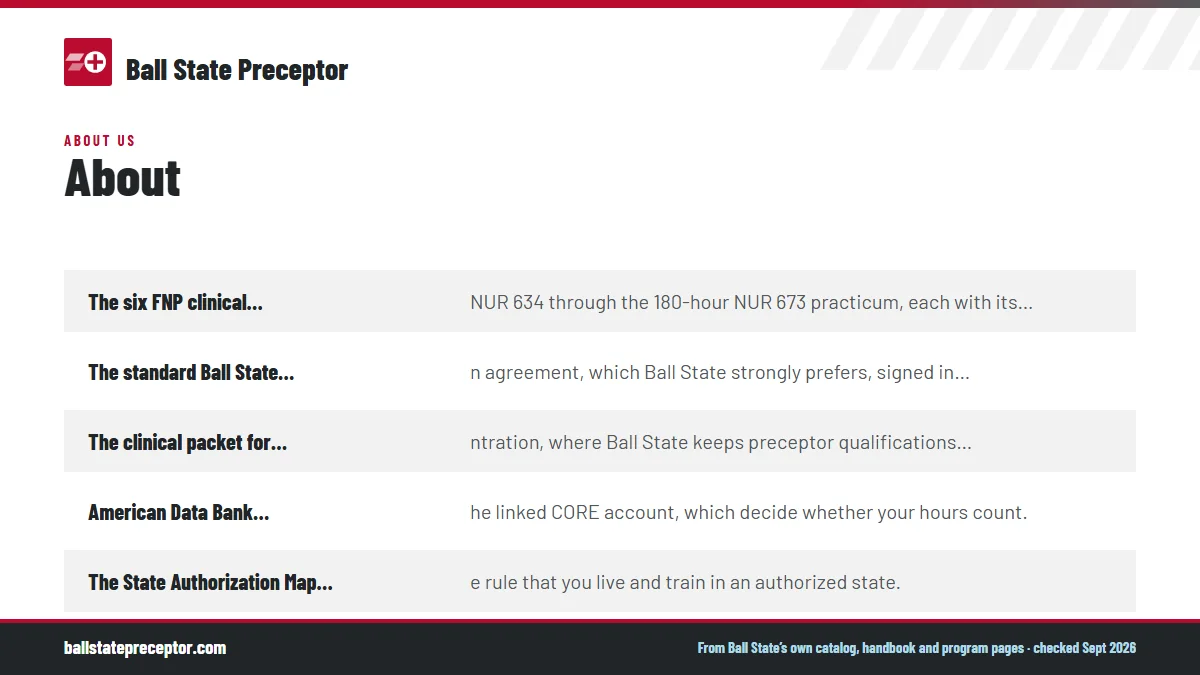
- The six FNP clinical courses, from
NUR 634through the 180-hourNUR 673practicum, each with its own specialty and pace, and theNUR 681clinical day on the Muncie campus. - The standard Ball State affiliation agreement, which Ball State strongly prefers, signed in original form and started about a semester ahead.
- The clinical packet for your concentration, where Ball State keeps preceptor qualifications, forms and deadlines.
- American Data Bank clearance and the linked CORE account, which decide whether your hours count.
- The State Authorization Map and the rule that you live and train in an authorized state.
- The rule against clinicals in your own unit or clinic, and Ball State's notes on health systems it will not use in some states.
The placement process guide shows how these fit together from first search to first hour.
How thorough we are
A preceptor who agrees to take you is only the start. Before a site reaches you, your placement advisor has checked it against every Ball State rule that could stop it later:
- The preceptor's specialty and caseload fit the exact course, including pediatric patients for
NUR 682and women's health forNUR 684. - The setting is primary care or a clinic, outside your own unit or clinic, in a state authorized for your program.
- The agency is clear of Ball State's list of excluded health systems, and its own student rules, application windows and residency or licensure limits suit you.
- Someone at the agency with signing authority is ready for Ball State's standard agreement, and the route for the original document is known.
- The preceptor can fit your hours inside the term, on days you can attend.
- Your American Data Bank dates run past the end of the course, or you know what to renew first.
- A second agency is ready for the same term.
A preceptor's yes is half the job. The other half is the agreement, the timing, the clearance and Ball State's own rules, and that half is where we spend most of our effort.
Ball State decides, we prepare
Every approval belongs to Ball State. Course faculty and the School of Nursing review each preceptor and site, the Graduate Clinical Placement Coordinator and the SON Graduate Program and Compliance Coordinator handle agreements, onboarding and clinical paperwork, and faculty support students when issues arise during the process.
Our part is to make sure that what lands in front of those people is complete, fits the course and arrives early. You still submit your own clinical paperwork and keep your own clearance current. The who does what guide shows which Ball State role to contact about what.
How we work with you
We start as early as you let us, ideally a year before the course, which is what Ball State's graduate handbook advises. You hear from one placement advisor in plain language, with the preceptor, the site, the agreement contact and the backup set out in writing. We plan beyond the next course when that helps, since the FNP's clinical courses follow one another term after term.
Once hours begin, we stay on call. If a preceptor steps away, a schedule collapses or an agency changes its mind, your placement advisor starts a replacement search at once and tells you what Ball State needs to hear about the change. How it works walks through each stage.
Where our information comes from
Every guide on this site is written from Ball State's own documents: the 2026-27 graduate catalog, the Graduate Nursing Handbook 2025-26, the School of Nursing's Current Student Resources page, Ball State Online's program pages and the State Authorization Map. Indiana facts come from the Indiana Code and the Board of Nursing's rules, and health system rules from each system's own student pages.
Where Ball State's documents disagree, we show both versions and date them, such as 690 or 735 FNP hours and 1,000 or 750 DNP hours. Where Ball State keeps something private, like the clinical packets, we say where it lives rather than guess. Your course faculty, your advisor and the Graduate Clinical Placement Coordinator have the final word. To start, send your details on the request form.
Questions Ball State students ask
Who will I work with at Ball State Preceptor?
One placement advisor at our placement desk, who handles your search from the first message through the end of the course. You can reach the desk through the form, the chat on every page or the message buttons, and your placement advisor keeps the full picture of your track, courses and site so you never have to explain it twice.
Do you help students outside Indiana?
Yes, in every state where Ball State's MS in Nursing is authorized, which is Indiana and 25 other jurisdictions on the State Authorization Map. The post-master's FNP certificate and the DNP are authorized in fewer states, so we check your program's list before any search starts. The state authorization guide sets out each list.
How is your search different from calling practices myself?
You could make the same calls, and some students do. The difference is time and completeness: we approach practices already matched to your course, confirm the agreement and signer before you commit, check the site against Ball State's rules, and keep a backup ready. Your own search or ours compares the two fairly.
How do you know what Ball State's clinical packet requires?
The packets are available only to enrolled students through Canvas, so we work from the packet pages you share with us, alongside Ball State's public catalog, handbook and program pages. When the packet leaves a question open, such as whether a certain clinician qualifies, we ask you to confirm it with your course faculty before a site is final.
Related pages
Last checked 2026-09-26
We check these pages against Ball State's own catalog, graduate handbook, program pages and State Authorization Map, and Indiana rules. Your course faculty, your advisor and the Graduate Clinical Placement Coordinator have the final word.
Ball State asks you to find your preceptor. We find one near you.
Tell us your Ball State track, where you live and when your next clinical course starts. We find preceptors near you who fit the course, confirm the practice will sign Ball State's affiliation agreement, and line up a backup, so the School of Nursing can clear the site before the semester.
- Preceptors matched to the course: pediatrics for
NUR 682, women's health forNUR 684, adult primary care forNUR 681andNUR 683 - Outside your own unit or clinic, in a state where Ball State's program is authorized
- Across Indiana, from Muncie to Evansville, and in the other states Ball State accepts
Start your placement plan
Program, city and start date is all we need to begin.