Ball State's Post-Master's FNP Certificate: hours by prior degree, states and preceptors
Ball State's online Post-Master's Certificate in Nursing, Family Nurse Practitioner runs 13 to 23 credits and 390 to 690 clinical hours, depending on what your first master's already covered. It admits residents of a short list of states only, and Ball State's own documents disagree on that list. As on the MS route, you find your own preceptors in your geographic area.
Plan your certificate preceptors
Tell us your state, the courses your transcript review assigned and when they start. A placement advisor replies with preceptor options near you.
What the certificate is and who gets in
The certificate prepares a nurse who already holds a master's degree for national FNP certification through the ANCC exam, the AANP exam or both. It is delivered online, admits in fall and spring with priority deadlines of July 19 and September 15, and must be finished within five years under the catalog's certificate limit. Transfer credit cannot count toward it.
Ball State's application page calls admission highly competitive with limited space and gives preference to graduates of its own MS in Nursing. The same page states that the certificate is not eligible for federal aid, so budget for another way to pay; the Office of Financial Aid and Scholarships can talk through what remains open to you.
CCNE accredits Ball State's post-graduate APRN certificate program through June 30, 2031, the same term as the master's.
Your prior degree sets the hours
A transcript review, often called the gap analysis, decides which courses you take. The catalog publishes two tracks, and the certificate page lists the hours for each course; adding them produces the 390 to 690 range.
| Your master's | Credits | Clinical courses | Hours |
|---|---|---|---|
| A concentration that is not NP, such as education or administration | 21-23 | NUR 681, NUR 682, NUR 683, NUR 684, NUR 673 | 630, or 690 with NUR 634 |
| Adult NP or Adult-Gerontology NP | 13-15 | NUR 682, NUR 684, NUR 673 | 390, or 450 with NUR 634 |
The review can add NUR 630, NUR 632, NUR 634 or NUR 638 to either track, and NUR 634 Advanced Health Assessment brings 60 clinical hours of its own. NUR 605 is added only when your master's is from another school; the certificate page lists it at 2 credits and the catalog at 3. If your master's is in a different NP specialty, neither published track matches it exactly, so ask admissions how the review will treat it.
For adult and adult-gerontology NPs, the new ground is pediatrics in NUR 682 and women's health in NUR 684, followed by the 180-hour NUR 673 practicum. The clinical hours planner sets these totals beside the MS route.
Which states: three Ball State answers
Where you live decides eligibility, and every clinical and classroom course must be completed in an approved state. Ball State's documents give three different lists.
| Ball State source | States named |
|---|---|
| Graduate Nursing Handbook 2025-26 (updated November 7, 2025) | Indiana and Ohio only, with an unencumbered Indiana or Ohio RN license |
| Certificate application page (read September 2026) | 8: Indiana, Alaska, Connecticut, Maine, Missouri, Ohio, Oregon and Utah |
| State Authorization Map (entry last saved August 27, 2025) | 9: the same eight plus Washington |
Indiana and Ohio appear on all three, so residents there face no doubt. Alaska, Connecticut, Maine, Missouri, Oregon and Utah appear on the two web sources but not in the handbook, and Washington appears only on the map. If you live in any of those seven, ask the Office of State Authorizations and graduate admissions to confirm your state in writing before you apply.
This footprint is far smaller than the MS in Nursing's 26 jurisdictions. Illinois, Michigan, Kentucky, Florida and Wisconsin are open for the MS but appear on none of the certificate lists. The state authorization guide compares every Ball State program.
The one-day orientation in Muncie
The certificate's application page requires a one-day orientation on the Muncie campus. That reads firmer than the MS in Nursing application page, which offers the orientation in person or by Zoom, and the 2025-26 graduate handbook, which describes a virtual graduate orientation for everyone. Treat the trip as required unless admissions tells you otherwise.
The MS FNP also holds an 8-hour clinical day on campus inside NUR 681, and the certificate page never mentions it. If your plan of study includes NUR 681, ask your advisor whether that day applies to you so a second trip does not surprise you. The catalog makes travel for clinical experiences the student's cost, and a campus clinical day would fall under that rule.
Clearance and grades still apply
Certificate students clear the same School of Nursing hurdles as master's students. Health clearance runs through American Data Bank, linked to CORE in your first clinical semester, and graduate registration is granted by permission only to students whose clearance is current. Hours logged while you are noncompliant must be repeated, so a lapsed TB test or license upload can cost you clinical days already worked.
Grades follow the master's rules. Anything below a B fails a NUR course, a second failure means dismissal, and an Incomplete in NUR 634 or any of NUR 681 to NUR 684 bars you from the following NP clinical course until you clear it. If you move, the Clinical Placement Coordinator needs your old and new state within seven days, and a move outside the approved list stops your coursework.
Preceptors in your geographic area
Ball State's certificate page is direct: you find your own preceptors in your geographic area. The MS FAQ's expectations carry over, with an active role asked of you and faculty support if a problem arises. The complete wording, and what it means week to week, is on finding your own preceptor.
Two things tighten the certificate search. Your preceptors must practice in the approved state where you live, and a short course list leaves little slack between one clinical course and the next. The handbook's advice to start planning a year before each clinical course applies in full, as does the one-semester lead time for the standard Ball State affiliation agreement and a backup agency each term.
Ball State's FAQ keeps clinical hours off your own unit and out of your own clinic. If you already practice as an adult NP, your current clinic cannot host your pediatric or women's health hours either.
How we help certificate students
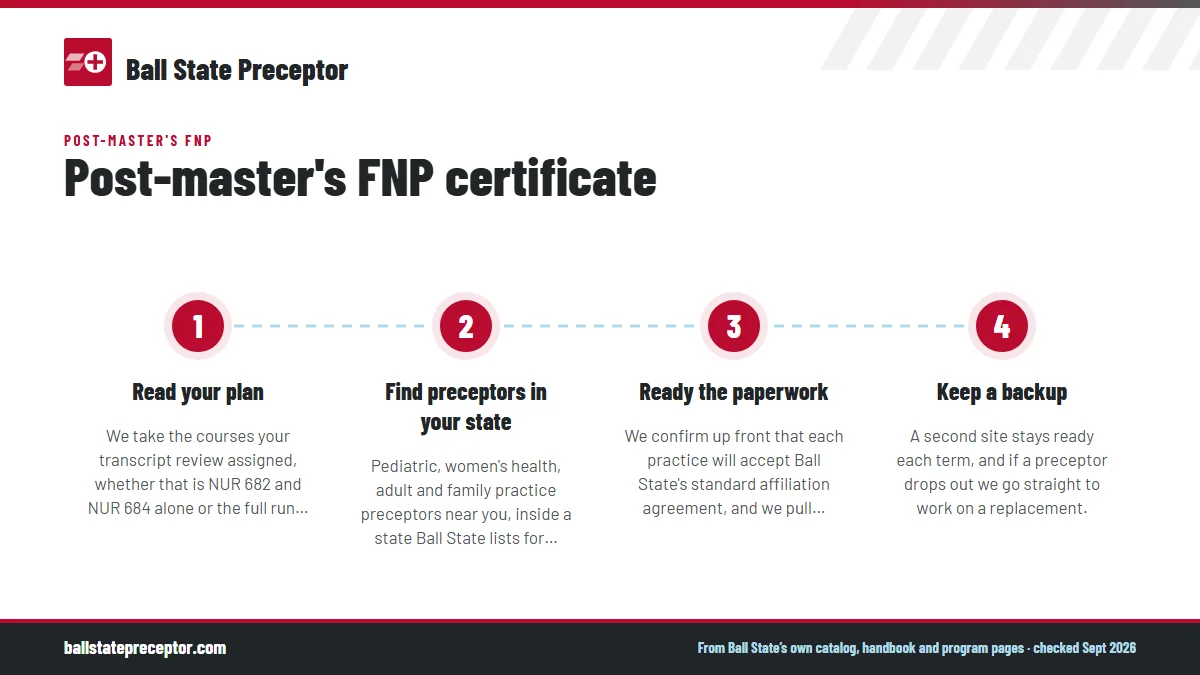
We work from your gap analysis and the state you live in, and we start as soon as your courses are known.
- Read your planWe take the courses your transcript review assigned, whether that is
NUR 682andNUR 684alone or the full run fromNUR 681toNUR 673, and set a search start for each. - Find preceptors in your statePediatric, women's health, adult and family practice preceptors near you, inside a state Ball State lists for the certificate and outside your own clinic.
- Ready the paperworkWe confirm up front that each practice will accept Ball State's standard affiliation agreement, and we pull together the clinical packet details a term before you need them.
- Keep a backupA second site stays ready each term, and if a preceptor drops out we go straight to work on a replacement.
Placements are cleared by Ball State's faculty and School of Nursing staff, and we get a complete, well-matched file in front of them early. Start with the placement request form.
Questions Ball State students ask
Can I use federal financial aid for Ball State's post-master's FNP certificate?
No. Ball State's application page says the certificate is not eligible for federal aid. Ask the Office of Financial Aid and Scholarships which other options fit, and check whether your employer helps with tuition. The School of Nursing also offers a graduate scholarship, with applications usually sent in February, though Ball State does not say whether certificate students qualify.
How long do I have to finish the certificate?
Five years. Ball State's catalog sets that limit for every certificate, one year less than the master's. Transfer credit cannot count toward a certificate, so every course your transcript review assigns is taken at Ball State. The handbook adds that three semesters without a nursing course archives your health clearance account.
Does Ball State prefer its own MSN graduates for the certificate?
Yes. The application page says admission is highly competitive, space is limited and preference goes to Ball State MS in Nursing graduates. Fall and spring are the only starts, with priority deadlines of July 19 and September 15. Ball State alumni also skip NUR 605, which the catalog adds only when the master's came from another school.
Is the post-master's FNP certificate accredited?
Yes. CCNE lists Ball State's post-graduate APRN certificate program as accredited since October 7, 2020, with the current term running through June 30, 2031. Indiana's rules also expect nurse practitioners who trained through a certificate program to earn and keep national certification, so plan for the board exam once you finish.
Can I do the certificate if I live in Illinois or Michigan?
Not on any current Ball State list. Illinois and Michigan are open for the MS in Nursing but absent from all three certificate lists, and certificate students must live and complete every course in a listed state. If you plan to move during the program, check the map for your new state before you commit to a start term.
Related pages
Last checked 2026-09-26
We check these pages against Ball State's own catalog, graduate handbook, program pages and State Authorization Map, and Indiana rules. Your course faculty, your advisor and the Graduate Clinical Placement Coordinator have the final word.
- Ball State: Post-Master's Certificate, FNP (online)
- Ball State: apply, Post-Master's Certificate in Nursing FNP
- Ball State: 2026-2027 Graduate Catalog, Post-Master's Certificate FNP
- Ball State State Authorization Map: Post-Master's Certificate FNP
- CCNE: accredited post-graduate APRN certificate programs
Ball State asks you to find your preceptor. We find one near you.
Tell us your Ball State track, where you live and when your next clinical course starts. We find preceptors near you who fit the course, confirm the practice will sign Ball State's affiliation agreement, and line up a backup, so the School of Nursing can clear the site before the semester.
- Preceptors matched to the course: pediatrics for
NUR 682, women's health forNUR 684, adult primary care forNUR 681andNUR 683 - Outside your own unit or clinic, in a state where Ball State's program is authorized
- Across Indiana, from Muncie to Evansville, and in the other states Ball State accepts
Start your placement plan
Program, city and start date is all we need to begin.