Finding your own preceptor at Ball State, in the School's own words
Ball State's nurse practitioner students locate their own preceptors. The FNP and certificate pages say so directly, the MS FAQ asks every master's student to take an active role with faculty support behind them, and the Graduate Nursing Handbook advises starting a year ahead. This page quotes each source in full, explains what it asks of you, and shows how our placement desk runs the search.
Get your placement plan
Tell us your Ball State program and where you live. A placement advisor replies with preceptor and site options in your community that fit your Ball State course.
Ball State's words, source by source
Four current Ball State sources address who finds the preceptor. Here they are exactly as published, with the page each one comes from.
- Family Nurse Practitioner concentration page, Ball State Online: "You will find your own preceptors in your community to supervise your clinical hours."
- Post-Master's Certificate page: "You will need to find your own preceptors in your geographic area."
- MS in Nursing program FAQs: "The School of Nursing expects students to play an active role in securing all clinical placements required for their degree. Faculty members are available to provide support and assistance should any issues arise during the process."
- The same FAQ, on location: "Clinicals are generally completed within your geographic area with a preceptor you select based on the requirements of the course."
The FAQ speaks to every MS concentration, not only the FNP, so Nurse Educator and Leadership and Management students also choose the RN who supervises their practicum. The FAQ carries some dated figures elsewhere, such as credit totals from an earlier curriculum, but its placement wording lines up with the current FNP and certificate pages.
The handbook's one-year advice and its warning
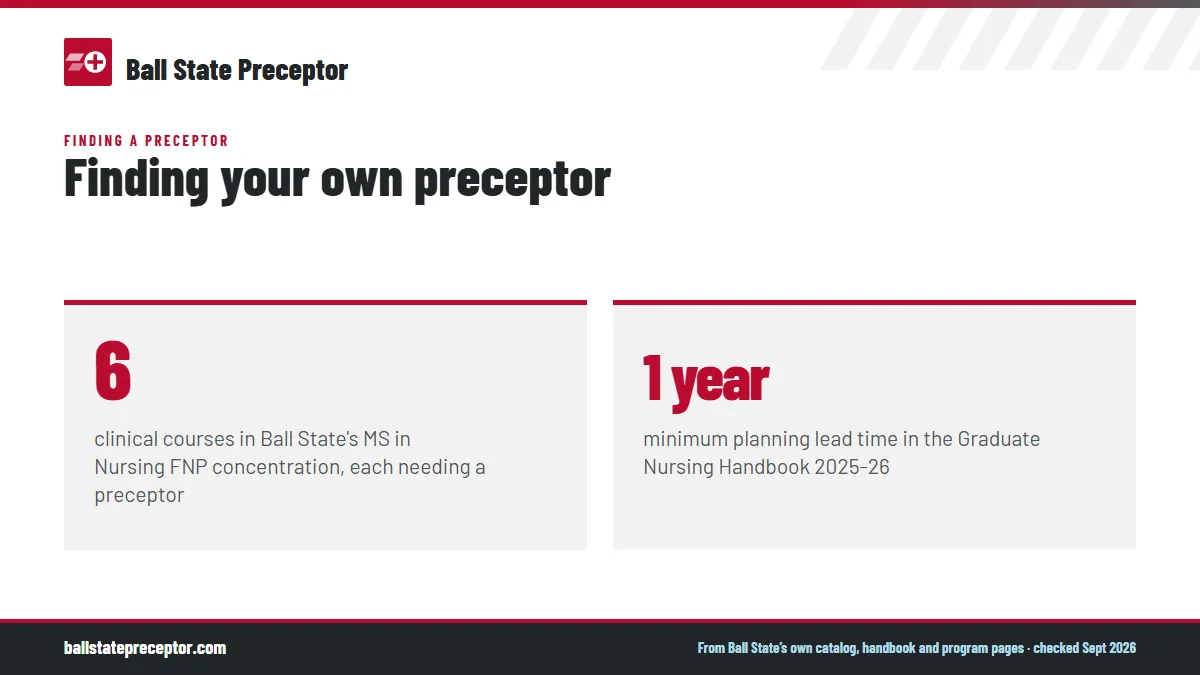
The Graduate Nursing Handbook 2025-26, still the edition Ball State links for graduate students, sets the timing out plainly: "Students should start planning clinical experience at least one year in advance of when they are scheduled to take the course. Often students find there is competition for clinical placement and planning early may help in securing a spot. Students who wait and begin looking for clinical placement one or two months before the deadline may well be unable to secure an appropriate clinical site, clinical supervisor, and/or preceptor."
Two details matter. Competition means other students are asking the same clinicians for the same semesters, so an early ask gets a better answer. And the warning names three separate pieces, the site, the clinical supervisor and the preceptor, so a willing clinician is only part of the job. The agency's contract then needs about a semester of its own, covered in the affiliation agreements guide.
Starting the search one or two months before the deadline is the exact mistake the handbook warns about. Count back a full year from each clinical course on your plan of study.
How Ball State supports the search
Ball State backs students while they search. The MS in Nursing landing page describes the School as "committed to supporting students in planning their clinical experiences" and promises to work closely with students on the plan of study and on meeting clinical requirements. The FAQ offers faculty support when issues arise, and the handbook's staff table gives the SON Graduate Program and Compliance Coordinator clinical placement and preceptor onboarding among its duties.
Sometimes faculty go further, and the FAQ sets the terms: "In the event that a faculty member does assist in securing placement for a student, the student will be required to accept the placement found for them. If they do not accept the placement for any reason, including location of the clinical site, they will have to wait to take the course in a future semester." That is a safety net with a condition attached rather than a placement promise, and the site may be farther from home than you would choose.
Who the rule covers
The student-led search applies across Ball State's graduate programs, with two clear exceptions: the DNP project site, which is settled with a committee, and the on-campus BSN, where the School arranges clinicals.
| Program | Who arranges it | Ball State source |
|---|---|---|
| MS in Nursing FNP | You find preceptors in your community | FNP concentration page; MS FAQ |
| Post-Master's Certificate FNP | You find preceptors in your geographic area | Certificate page |
| MS Nurse Educator; Leadership and Management | You select a master's- or doctoral-prepared RN and may train in your workplace | Concentration pages; MS FAQ |
| DNP, FNP cognate clinicals | No current public statement; confirm with your advisor | None published |
| DNP project site, all cognates | You confirm it with your DNP Project Committee by the start of NUR 792 | Graduate Nursing Handbook |
| BSN in Muncie | The School places you with agencies in east-central Indiana | BSN program page |
What a workable Ball State preceptor looks like
A clinician who says yes is the start, not the finish. For Ball State, the preceptor and the site also have to clear several checks before the course opens.
- Location: you must live in, and complete every clinical hour in, a state where Ball State is authorized for your program. See clinicals outside Indiana.
- Setting: FNP clinicals run in primary care or a clinic rather than acute care, and not in your own unit or clinic. The workplace guide covers the gray areas.
- Course fit:
NUR 682centers on children,NUR 684on women's health, andNUR 673asks for 180 hours at about 1.5 to 2 days a week. - Qualifications: the preceptor has to meet the qualification list in your concentration's clinical packet, which only enrolled students can open.
- The agency: it has to be willing to sign Ball State's affiliation agreement and cannot be one of the systems Ball State rules out in certain states.
- The health system's own rules: IU Health's student page, for example, says only students whose primary residence and nursing license are in Indiana are eligible, and it asks students not to contact its providers directly.
How we take the search off your plate
Ball State asks you to own the search; we make that search fast and thorough. Your placement advisor starts from your plan of study and the exact Ball State course, works the practices and clinics around you that suit it, confirms the clinician's willingness and capacity for your semester, and checks the site against Ball State's rules before you hear a name.
Once a preceptor agrees, we gather what the clinical packet and the affiliation agreement will need, identify who at the agency signs, and keep a second option warm, a semester or more ahead, just as Ball State advises. If a preceptor drops, we find a replacement for the same course. Your course faculty and the School of Nursing still review and approve every site, and we make sure what reaches them is complete. See how it works or use the form below.
Questions Ball State students ask
Does Ball State assign preceptors to FNP students?
No. Ball State's current FNP and certificate pages say students find their own preceptors. Faculty support you if issues arise, and a faculty member may occasionally secure a site, but then you take it or wait for a later semester. BSN students are the exception: the School places them with agencies in east-central Indiana.
Can Ball State students use a preceptor placement service?
Ball State's public pages, handbooks and catalog say nothing about placement services, for or against. A site found this way goes through the same affiliation agreement, clinical packet, compliance checks and faculty review as a site you found alone. The side-by-side comparison weighs the two routes honestly.
When should I start looking for a preceptor for NUR 681?
NUR 681 Primary Care of the Adult 1 is the first primary care clinical after NUR 634, with 120 hours that include an 8-hour day on campus in Muncie. Following the handbook, start at least a year before your plan of study schedules it, and have the agency working on the agreement about a semester out.
Does my preceptor have to sign anything for Ball State?
The agency signs Ball State's affiliation agreement. The preceptor's part runs through your clinical packet, which lists preceptor qualifications and responsibilities and holds the evaluation forms and a clinical time sheet. The SON Graduate Program and Compliance Coordinator handles the onboarding information preceptors receive from Ball State.
What should I do if no preceptor near me says yes?
Tell your course faculty early, because Ball State's FAQ says faculty are available when issues arise, and remember that a faculty-found site must be accepted. Meanwhile, widen the practice types you approach within your authorized state. Our guide for students without a preceptor sets out the steps for this week.
Related pages
Last checked 2026-09-26
We check these pages against Ball State's own catalog, graduate handbook, program pages and State Authorization Map, and Indiana rules. Your course faculty, your advisor and the Graduate Clinical Placement Coordinator have the final word.
Ball State asks you to find your preceptor. We find one near you.
Tell us your Ball State track, where you live and when your next clinical course starts. We find preceptors near you who fit the course, confirm the practice will sign Ball State's affiliation agreement, and line up a backup, so the School of Nursing can clear the site before the semester.
- Preceptors matched to the course: pediatrics for
NUR 682, women's health forNUR 684, adult primary care forNUR 681andNUR 683 - Outside your own unit or clinic, in a state where Ball State's program is authorized
- Across Indiana, from Muncie to Evansville, and in the other states Ball State accepts
Start your placement plan
Program, city and start date is all we need to begin.