Clinicals where you work: what Ball State allows
Two Ball State pages point different ways. The MS FAQ says clinicals cannot be done in your own unit or clinic, while the Nurse Educator and Leadership and Management pages let the 180-hour NUR 672 practicum run at your workplace. Read together, your employer can often host you but your own unit or clinic cannot, and any site inside your employer deserves a written yes from course faculty first.
Get your placement plan
Tell us your Ball State program and where you live. A placement advisor replies with preceptor and site options in your community that fit your Ball State course.
Two Ball State statements, side by side
The conflict is real, so look at the exact sources before you plan around either one.
| Source | What it says | Who it covers |
|---|---|---|
| MS in Nursing FAQs (undated) | Clinicals cannot be done in your own unit or clinic | Stated generally, with no concentration named |
| Leadership and Management page (current) | The 180-hour practicum can be completed at your place of health care employment, under a master's- or doctoral-prepared RN | NUR 672, leadership students |
| Nurse Educator page (current) | The 180 practicum hours can be completed in your workplace under the same kind of RN | NUR 672, educator students |
| Master's information packet, Fall 2018 (archived) | Clinicals could not be done in your unit or clinic | An older version of the FAQ line |
Several figures on the FAQ, such as its credit totals and educator hours, match the 2018 curriculum rather than the current pages, so parts of it are older than the concentration pages. That does not cancel the own-unit line, which has run through Ball State's material since at least 2018.
The likely reading: employer yes, own unit no
The two lines fit together if workplace means employer and unit means the team you work on. A leadership student employed by a health system could run a NUR 672 project in another department of that system, and an FNP student employed by a hospital could train in one of its outpatient primary care clinics, provided neither is the student's own unit or clinic. Ball State never states this reading in one place, so treat it as likely rather than settled.
The FNP setting rule narrows things further. Ball State wants FNP hours in primary care or a clinic, never acute care, so a floor nurse's own hospital unit fails twice over. For FNP students the practical question is whether an employer's separate primary care, pediatric or women's health clinic will count.
Put the answer in writing. Describe the site, your job with the employer and the proposed preceptor to your course faculty, and ask for approval before the agency signs anything.
FNP students: using an employer's other clinics
A large employer is an asset once you look past your own clinic. A system with many primary care offices may run a pediatric practice that suits NUR 682 or a women's health clinic for NUR 684, staffed by people who do not know you as a colleague. Some systems favor their own staff: Community Health Network says on its student page that Community caregivers are prioritized, and Franciscan Health gives priority placement to its employees.
Use the employer's formal student route, not the break room. IU Health, according to its own pages, routes nurse practitioner students through its Office of Clinical Education database in fixed application windows, admits to that process only students who live in Indiana and are licensed there, and tells students not to contact its providers to arrange their own preceptor. Treat those rules as applying to you as an employee too, unless that office tells you otherwise.
Whatever the employer, the agency still has to sign Ball State's standard affiliation agreement, and a semester of lead time is what Ball State suggests. If your employer operates outside Indiana, check the health systems Ball State will not use before you ask.
Educator and leadership students: the practicum at work
NUR 672 is where the workplace clearly helps. Ball State lets its 180 hours run at your place of employment under a master's- or doctoral-prepared RN, with a leadership focus for leadership students and an education focus for educators. The catalog frames the course as a practicum in an educational or administrative setting, which fits a professional development department, a quality office or a nursing administration team.
Two questions stay open in the public sources. Ball State does not say whether your preceptor may be your direct supervisor, and it does not say whether a project inside your own unit falls under the FAQ's own-unit line. Ask your course faculty both before you pitch the project internally.
Choosing a project one step removed from your daily role, in a neighboring department or at the system level, usually answers both questions at once. The role practicum guide covers the course itself, and the preceptor requirements guide covers who may supervise it.
Setting up a placement with your employer
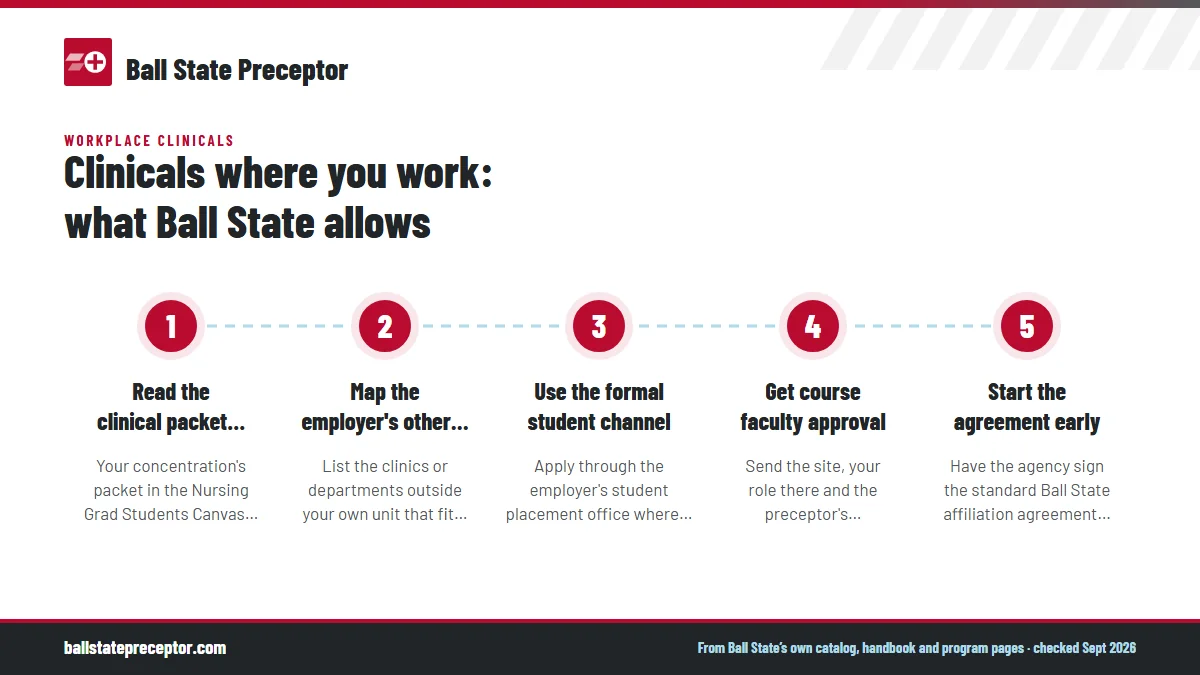
An employer site still moves through Ball State's normal process. This order avoids the usual stalls.
- Read the clinical packet firstYour concentration's packet in the Nursing Grad Students Canvas Community holds the placement policies and paperwork deadlines for the course.
- Map the employer's other sitesList the clinics or departments outside your own unit that fit the course, and who leads each one.
- Use the formal student channelApply through the employer's student placement office where one exists, and follow any rule against contacting providers directly.
- Get course faculty approvalSend the site, your role there and the preceptor's credentials, and keep the reply with your records.
- Start the agreement earlyHave the agency sign the standard Ball State affiliation agreement about a semester ahead; Ball State accepts only original documents.
- Keep a backup outside the employerBall State asks students to cultivate a backup agency each semester. An outside practice is the stronger backup, because one placement office can turn down every site inside the same employer at once.
When your employer's clinics are not an option
Sometimes an employer simply cannot host its own staff: the clinics are full, the application window has closed, or the only clinic that fits the course is the one you work in. That is where outside help earns its place. Your placement advisor searches independent practices and community clinics near you that fit the exact Ball State course, checks each one against the own-unit rule, the authorized-state rule and Ball State's excluded systems, and prepares what the affiliation agreement and the packet need.
Tell us where you work when you request a placement, so the search steers around your own unit and any site where reporting lines would get awkward. The placement process guide shows where this step sits in Ball State's sequence.
Questions Ball State students ask
Can I do my Ball State FNP clinicals at the clinic where I work?
Not in your own clinic. Ball State's MS FAQ rules out clinicals in your own unit or clinic, and the same line appears in its 2018 information packet. A different clinic run by the same employer may work, since the concentration pages accept workplace settings, but confirm that with your course faculty before the agency signs anything.
Can a coworker be my Ball State preceptor?
Ball State's public pages do not address coworkers by name. A preceptor in your own unit or clinic would place the clinical inside that unit, which the FAQ rules out. A colleague at a different clinic of the same employer is a question for your course faculty and your clinical packet, so ask before anyone commits.
Can leadership students complete NUR 672 in their own department?
Ball State's leadership page allows the practicum at your place of health care employment, but the MS FAQ also rules out your own unit, and nothing public reconciles the two for a project inside your own department. A project in a neighboring department or at the system level avoids the question. Otherwise, ask your course faculty first.
Can IU Health employees do NP clinicals at IU Health?
IU Health's own pages route nurse practitioner students through its Office of Clinical Education database, accept only Indiana residents licensed in Indiana, and tell students not to contact its providers directly. Treat those rules as applying to you as an employee as well, and ask that office about any employee pathway.
Related pages
Last checked 2026-09-26
We check these pages against Ball State's own catalog, graduate handbook, program pages and State Authorization Map, and Indiana rules. Your course faculty, your advisor and the Graduate Clinical Placement Coordinator have the final word.
Ball State asks you to find your preceptor. We find one near you.
Tell us your Ball State track, where you live and when your next clinical course starts. We find preceptors near you who fit the course, confirm the practice will sign Ball State's affiliation agreement, and line up a backup, so the School of Nursing can clear the site before the semester.
- Preceptors matched to the course: pediatrics for
NUR 682, women's health forNUR 684, adult primary care forNUR 681andNUR 683 - Outside your own unit or clinic, in a state where Ball State's program is authorized
- Across Indiana, from Muncie to Evansville, and in the other states Ball State accepts
Start your placement plan
Program, city and start date is all we need to begin.