Ball State affiliation agreements: the contract behind every clinical site
Before an agency can host you for a Ball State clinical course, the University and that agency need a signed affiliation agreement, also called an agency agreement. Ball State strongly prefers its own standard form, accepts only original signed documents, and suggests starting tentative arrangements about a semester ahead with a backup agency in reserve. Here is how each rule works and where students get caught.
Get your placement plan
Tell us your Ball State program and where you live. A placement advisor replies with preceptor and site options in your community that fit your Ball State course.
What the agreement is and why it gates the site
An affiliation agreement is the contract between Ball State University and the clinical agency where you train: the practice, clinic, hospital or health system behind your preceptor. The drug screen policy in the Graduate Nursing Handbook 2025-26 describes the arrangement plainly: the University keeps contracts with clinical agencies so nursing students can gain clinical education, and clinical sites keep the right to refuse any student.
Health systems set the same condition from their side. Community Health Network's student page says it accepts students only from universities with an active, fully executed legal affiliation agreement, and Franciscan Health and IU Health Ball Memorial's Student Placement Services list an agreement as a requirement on their own pages. Ball State's rules sit under General Guidelines Regarding Agency Agreements on the School of Nursing's Current Student Resources page, where the wording has held steady since at least 2019.
Standard Ball State agreement or the agency's own
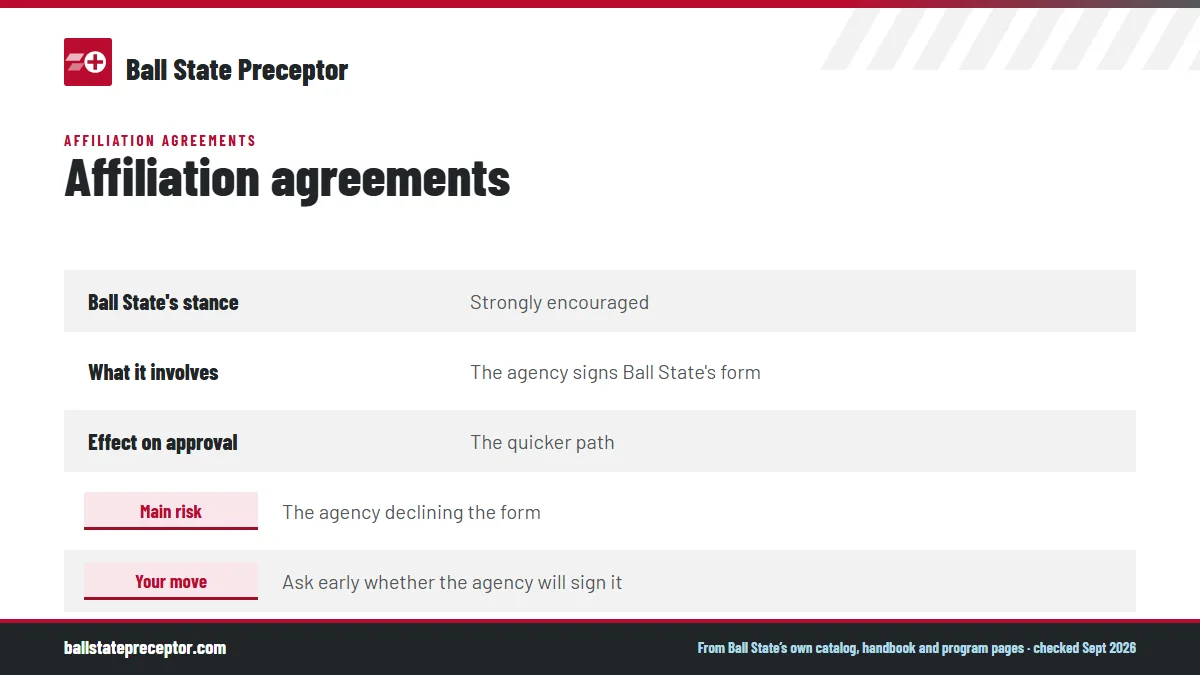
Ball State strongly encourages students to have agencies sign the standard Ball State University affiliation agreement. Some agencies prefer their own contract. Ball State allows that, but it cautions that review, revision, negotiation and signing of a non-Ball State agreement can add significant time before a placement is approved, and that the talks may not yield a usable agreement at all.
| Question | Standard Ball State agreement | Non-Ball State agreement |
|---|---|---|
| Ball State's stance | Strongly encouraged | Allowed, with a time warning |
| What it involves | The agency signs Ball State's form | Review, revision and negotiation between Ball State and the agency, then signing |
| Effect on approval | The quicker path | Can lengthen approval considerably |
| Main risk | The agency declining the form | Talks ending without a usable agreement |
| Your move | Ask early whether the agency will sign it | Start sooner and keep a backup agency moving |
Originals only
Ball State will not accept a finalized affiliation agreement that has been faxed, scanned, photocopied or photographed. Only the original document counts. The rule trips up students who assume an emailed PDF with every signature is enough.
So find out early who at the agency has signing authority, where that person sits and how the original will reach the School of Nursing. If the signer works from a regional or corporate office rather than the clinic where you train, allow extra days for the document to travel. The rule holds wherever the agency is, so a clinic across the country follows the same routine as one a few miles from Muncie.
A scanned, faxed, copied or photographed agreement does not count, even with every signature in place. Ball State accepts the original document only.
A semester ahead, a backup every term, and the systems to skip
Ball State encourages students to begin tentative arrangements for clinicals about one semester before the course, largely because agreement review takes time. That semester sits inside the handbook's broader advice to start planning a full year ahead, set out on finding your own preceptor.
The same page asks you to cultivate, well in advance, a possible backup clinical agency for every semester, as insurance in case talks between Ball State and your first agency fall through. Because the contract is with the agency rather than the individual clinician, a real backup is a second agency, not a second preceptor down the hall.
The Current Student Resources page also carries notes about clinical agencies by state. In a handful of states it names health systems whose facilities Ball State will not use, and for one state it warns that a contract with the agency you choose may not happen. Several of those states are not authorized for Ball State's MS in Nursing on the current State Authorization Map, which suggests the notes are older than the map. The list, in Ball State's words, is on clinical agencies by state.
Agreements, progression and DNP projects
DNP students meet a firmer checkpoint. The handbook requires all IRB approvals, all clinical clearance documentation, a practicum mentor agreement, an agency agreement and final approval from the project faculty advisor before project implementation begins. Ball State expects the project site to be settled with the DNP Project Committee as your NUR 792 semester opens.
Implementation runs through NUR 788 Leadership Immersion Practicum 2, NUR 793 DNP Project 2 and NUR 794 DNP Project 3, so a late agency agreement pushes back the project work that follows. The hour side is covered in DNP clinical hours.
Ball State's progression rules list agency contracts, next to the required clinical evaluation forms, as paperwork you must hand in according to policy. A missing agreement is therefore more than a scheduling snag; it sits with grades and compliance among the things that can stall your progress. Graduation also depends on turning in all final practicum documentation. The submission policies and deadlines for your concentration are in its clinical packet.
How we get an agency ready to sign
We raise the agreement at the first conversation with a site, not the last. Before a site reaches you, your placement advisor confirms whether the agency will sign Ball State's standard affiliation agreement, identifies who signs and how the original will travel, and flags any agency that requires its own contract so you can start sooner. We work to Ball State's semester-ahead timeline and keep a second agency ready every term. If an agency tells us it already hosts Ball State students, we pass that on so you can confirm the agreement on file with the Graduate Clinical Placement Coordinator.
Ball State and the agency make the agreement; we make sure the handoff to the School of Nursing is complete and early. Ask about your next course through the form below.
Questions Ball State students ask
Does my preceptor sign Ball State's affiliation agreement?
The agreement is between Ball State and the clinical agency, so it is signed by someone with signing authority at the agency, who may or may not be your preceptor. Your preceptor's own part, such as qualifications and evaluations, runs through the forms in the clinical packet for your concentration.
Do I need a new affiliation agreement every semester?
Ball State does not publish how long an agreement lasts or whether one already on file covers a new student. Ask the Graduate Clinical Placement Coordinator whether the agency has a current agreement with Ball State before starting fresh paperwork, and keep the backup agency Ball State recommends either way.
Who at Ball State handles affiliation agreements?
Ball State's public pages do not lay out the agreement workflow step by step. Placement matters and the handing in of clinical paperwork fall within the SON Graduate Program and Compliance Coordinator's remit, and the Graduate Clinical Placement Coordinator steers any question to whoever owns it. The who does what guide maps every role.
Can a clinical site still turn me down after the agreement is signed?
Yes. Ball State's graduate handbook states that clinical sites have the right to refuse any student for clinical placement, and its drug screen policy bars clinicals after a positive result. Keep your American Data Bank clearance current and your backup agency warm until your hours are under way.
Does a signed agreement mean my clinical site is approved?
Not on its own. The agreement lets the agency host Ball State students, but the site and its paperwork are still checked against the course by your faculty and School of Nursing staff, and your health clearance must be current before hours count. Your concentration's clinical packet sets out the remaining steps and deadlines.
Related pages
Last checked 2026-09-26
We check these pages against Ball State's own catalog, graduate handbook, program pages and State Authorization Map, and Indiana rules. Your course faculty, your advisor and the Graduate Clinical Placement Coordinator have the final word.
Ball State asks you to find your preceptor. We find one near you.
Tell us your Ball State track, where you live and when your next clinical course starts. We find preceptors near you who fit the course, confirm the practice will sign Ball State's affiliation agreement, and line up a backup, so the School of Nursing can clear the site before the semester.
- Preceptors matched to the course: pediatrics for
NUR 682, women's health forNUR 684, adult primary care forNUR 681andNUR 683 - Outside your own unit or clinic, in a state where Ball State's program is authorized
- Across Indiana, from Muncie to Evansville, and in the other states Ball State accepts
Start your placement plan
Program, city and start date is all we need to begin.