Who does what in a Ball State clinical course
One Ball State clinical course can involve a placement coordinator, a compliance coordinator, course faculty, an advisor, the Graduate Programs Director, the preceptor at your site and, for DNP students, a full project committee. The Graduate Nursing Handbook 2025-26 gives each a lane. This guide lists every role by title, what the handbook assigns it, and which questions belong with whom.
Get your placement plan
Tell us your Ball State program and where you live. A placement advisor replies with preceptor and site options in your community that fit your Ball State course.
If you are not sure who to ask
Ball State's handbook settles this directly: when you are unsure who handles a situation, contact the Graduate Clinical Placement Coordinator, who will direct you to the right person. That makes the placement coordinator the switchboard for clinical questions, not only for placements.
Send every message from your BSU email. The handbook says messages from personal accounts are deleted without a reply, however urgent, and it expects students to read and answer School of Nursing email within 48 hours, weekends excluded. This guide uses titles only; the current people in each role are listed in the handbook's contact table.
Online students also have a Ball State Online Student Success Specialist, the same person from application to graduation, who can help with questions that fall outside the School of Nursing.
The roles at a glance
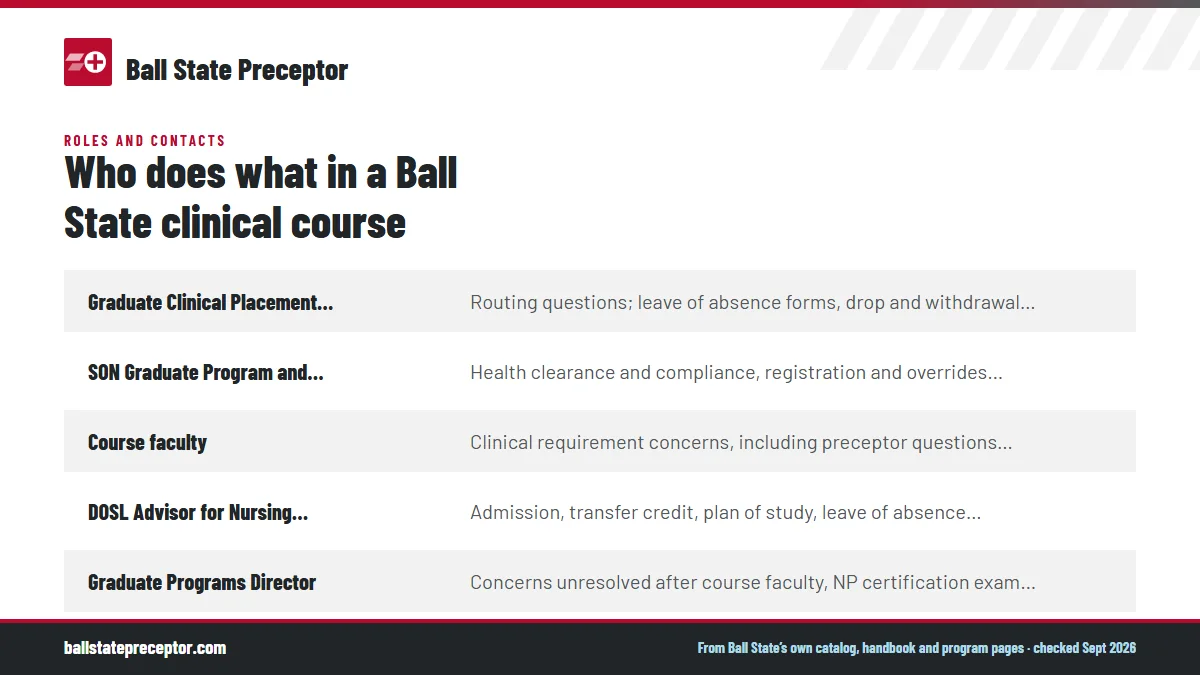
The table pairs each role with what Ball State's documents give it and the questions it is best placed to answer.
| Role | What Ball State assigns it | Ask about |
|---|---|---|
| Graduate Clinical Placement Coordinator | Routing questions; leave of absence forms, drop and withdrawal notices, moves, name changes, assistantship notices | Who owns your question; reporting a move or a drop |
| SON Graduate Program and Compliance Coordinator | Health clearance and compliance, registration and overrides, clinical paperwork submission, orientation, clinical placement, preceptor onboarding information | Compliance status, registration permission, where paperwork goes |
| Course faculty | Clinical requirement concerns, including preceptor questions and clinical hours; evaluating your clinical work | Whether a site fits the course, hours, evaluations |
| DOSL Advisor for Nursing Graduate Students | Admission, transfer credit, plan of study, leave of absence, graduation, withdrawal | Your plan of study and when each clinical course falls |
| Graduate Programs Director | Concerns unresolved after course faculty, NP certification exam applications, verification of education | Escalations, exam paperwork, license verification for other states |
| Graduate Admission and Progression (GAP) Committee | Appeals of compliance sanctions; petitions after long inactivity | Appeals, filed within three days |
| Preceptor | Supervising your clinical hours; evaluating you alongside course faculty | Schedule, patient mix, the clinical time sheet |
| Clinical supervisor | An added evaluator for students living in certain states | Ask course faculty whether your state needs one |
| DNP Project Committee | Approving the project proposal, including its site | Confirming the site by the start of NUR 792 |
| Project faculty advisor | Orienting the mentors, interviewing the project preceptor mentor, final approval before implementation | Project readiness and approvals |
| Project preceptor mentor | Committee seat, orientation to agency policies, a written evaluation of you | Agency protocols and the practicum |
| Content expert mentor | External member of the DNP Project Committee | The project's subject area |
Placement and compliance staff
The two coordinator titles are easy to confuse. The Graduate Clinical Placement Coordinator, written simply as Clinical Placement Coordinator in parts of the handbook, is where notices go: leave of absence forms, drops and withdrawals, a move to another state, a legal name change and assistantship news. The SON Graduate Program and Compliance Coordinator runs the working side, from health clearance and course overrides to clinical paperwork, orientation, clinical placement and the onboarding information preceptors receive.
Some notices run on a clock. Leaving a course, by drop or withdrawal, gives you three days to tell both the Clinical Placement Coordinator and the faculty teaching it. Changing states gives you seven days to fix your Banner address and send the Clinical Placement Coordinator both the state you left and the one you moved to, and your new license record must then clear review in American Data Bank. The handbook's drug screen policy also mentions a Nursing Compliance Coordinator without saying whether that is the same position.
Faculty, advisor and director
Course faculty are the first stop for anything clinical. The handbook sends concerns about clinical requirements, preceptor questions and clinical hours to them, and they evaluate your clinical performance together with your preceptor. Ball State's MS FAQ adds that faculty are available to help when issues arise during placement; its exact wording is on finding your own preceptor.
Your DOSL Advisor for Nursing Graduate Students, from the Division of Online and Strategic Learning, owns the plan of study, transfer credit, leaves, graduation and withdrawal. The Graduate Programs Director handles escalations: concerns still open after course faculty, the NP certification exam application, verification of education for boards or other states' licenses, approval to take more or fewer than two classes in a semester, and transfer credit for courses taken after you enroll.
Take preceptor and hour questions to course faculty first. The Graduate Programs Director is for concerns that remain unresolved after that conversation.
People at your clinical site
Your preceptor supervises your hours and, with course faculty, evaluates your clinical work; the qualifications and responsibilities they must meet are in your concentration's clinical packet. In the NUR 672 practicum, that person is an RN holding a master's or doctorate. For students who reside in some states, the handbook brings in a third evaluator, the clinical supervisor, and its planning advice treats the clinical site, clinical supervisor and preceptor as three separate things to secure. Which states need a clinical supervisor is not public, so ask course faculty or the Graduate Clinical Placement Coordinator before you commit to a site.
The agency is a party as well. It signs Ball State's affiliation agreement, and it keeps the final word on whether to take a given student. See affiliation agreements.
DNP project roles
DNP students work with a committee as well as a site. Choosing where the project will be carried out is a joint decision with the DNP Project Committee, due when your NUR 792 term opens. On that committee sits the project preceptor mentor, who introduces you to how the agency operates, then puts a written evaluation of your work in front of you before passing it to the project faculty advisor. The committee's outside member is the content expert mentor.
Your project faculty advisor sends both mentors written material explaining what Ball State expects, and speaks with the project preceptor mentor by phone as NUR 793 closes and again as NUR 794 closes. Implementation cannot begin until that advisor signs off and the IRB approvals, clearance records, mentor agreement and agency contract are all done. When the practicum ends, you rate the site and your mentor. Hours are covered in DNP clinical hours.
Where our placement desk fits
We sit outside Ball State's structure and work for you. Your placement advisor takes on the search and the groundwork: finding a preceptor who fits the course, confirming the agency will sign Ball State's agreement, and gathering what the packet and forms will ask for. You remain the contact with Ball State's faculty and staff, and every approval stays with them.
Knowing who does what lets us hand you the right material for the right person: site and preceptor details for course faculty, paperwork for the compliance coordinator, and the agency's signer for the agreement. If a site changes partway through, we point you to the people who need to hear about it. Tell us your program and next course in the form below.
Questions Ball State students ask
Who approves my preceptor at Ball State?
Ball State's public documents name no single approver. Course faculty handle preceptor questions and evaluate your clinical work, the SON Graduate Program and Compliance Coordinator handles clinical placement and paperwork, and for DNP projects the committee approves the site. The criteria a preceptor must meet are in your concentration's clinical packet.
Who handles registration for a Ball State clinical course?
You cannot enroll in a nursing course on your own. Permission comes from the School, keyed to your plan of study, and it is held back if any health clearance item is outstanding; registration, course numbers and overrides fall to the SON Graduate Program and Compliance Coordinator. Watch your BSU email and the Canvas Community for the course numbers.
How do I appeal a Ball State compliance sanction?
Appeals go to the Graduate Admission and Progression Committee within three days. To clear a sanction, the handbook has students show American Data Bank's confirmation email or a screenshot of a fully compliant dashboard to their instructor, since instructors hear nothing from ADB directly. Each noncompliant week also costs points in each course.
Who handles my NP certification exam paperwork?
The handbook gives the Nurse Practitioner Certification Exam Application and verification of education for certification exams to the Graduate Programs Director. Ball State's FNP completers choose between the AANP and ANCC boards, and the handbook permits testing either in your last semester or once you finish. More on NP certification exams.
Who do I contact if my preceptor cancels mid-semester?
Start with your course faculty, who handle preceptor questions and clinical hours, and if you are unsure who else needs to know, the Graduate Clinical Placement Coordinator will point you onward. Ball State's advice to keep a backup agency each semester exists for this moment, and our placement desk can begin on a replacement straight away.
Related pages
Last checked 2026-09-26
We check these pages against Ball State's own catalog, graduate handbook, program pages and State Authorization Map, and Indiana rules. Your course faculty, your advisor and the Graduate Clinical Placement Coordinator have the final word.
Ball State asks you to find your preceptor. We find one near you.
Tell us your Ball State track, where you live and when your next clinical course starts. We find preceptors near you who fit the course, confirm the practice will sign Ball State's affiliation agreement, and line up a backup, so the School of Nursing can clear the site before the semester.
- Preceptors matched to the course: pediatrics for
NUR 682, women's health forNUR 684, adult primary care forNUR 681andNUR 683 - Outside your own unit or clinic, in a state where Ball State's program is authorized
- Across Indiana, from Muncie to Evansville, and in the other states Ball State accepts
Start your placement plan
Program, city and start date is all we need to begin.