FNP certification after Ball State: eligibility, the board review and timing
Ball State says its FNP graduates are eligible to apply for FNP certification through ANCC and/or AANP, and the Graduate Nursing Handbook lets students test in their last semester or after they finish. A board review course is a required part of NUR 673, paid straight to the outside company that provides it. Ball State has published no FNP certification pass rate since its 2014-15 annual report.
Keep your final semester, and your exam date, on schedule
Tell us when you expect to reach NUR 673. We line up a family practice preceptor who can carry the 180 hours, with a backup in view.
Who is eligible, and for which exam
Every Ball State route to FNP ends at the same national exams. The MS in Nursing FNP page and the Post-Master's Certificate page both promise completers eligibility to apply for the ANCC and/or AANP family nurse practitioner exam. The handbook extends the same path to post-baccalaureate DNP graduates of the FNP cognate.
The handbook names the two certifying agencies as the American Academy of Nurse Practitioners (AANP) and the American Nurse Credentialing Center (ANCC). You may choose one or take both. Each certifier sets its own application steps, eligibility review and fees, so read its current candidate handbook on its own site before you register.
The educator and leadership concentrations of the MS in Nursing prepare for different roles through the NUR 672 practicum and are outside this path; FNP is Ball State's only nurse practitioner specialty.
The board review inside NUR 673
NUR 673 Practicum-Family Nurse Practitioner is the final course of the FNP sequence: 180 clinical hours, averaging 1.5 to 2 clinical days weekly, with every other FNP course as its prerequisite. The handbook makes a review course a required part of the practicum and says students pay their fees directly to the company that provides the review. Ball State's public documents leave the company unnamed, so ask your NUR 673 faculty which review to use and how to enroll.
Plan the money and the hours together. The review falls in the same term as your heaviest clinical load, the handbook also requires the Exit and Graduate Surveys, and graduation requires submitting all final practicum documentation. The NUR 673 guide covers the practicum itself, from hours to preceptor fit.
When to test: the last semester or after you finish
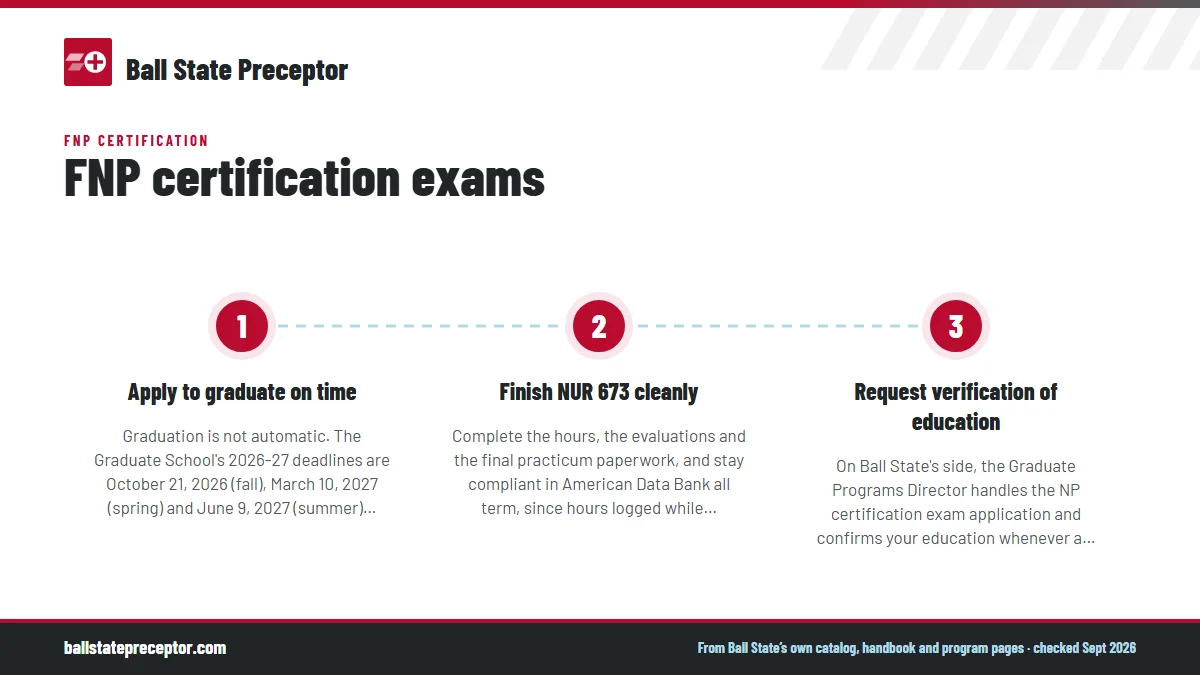
The handbook allows you to sit for the exam in your last semester or once the program is complete. Either way, three Ball State steps stand between you and a test date:
- Apply to graduate on timeGraduation is not automatic. The Graduate School's 2026-27 deadlines are October 21, 2026 (fall), March 10, 2027 (spring) and June 9, 2027 (summer), each at 11:59 p.m. Eastern, and it turns late applications away. The academic calendar has the other dates.
- Finish NUR 673 cleanlyComplete the hours, the evaluations and the final practicum paperwork, and stay compliant in American Data Bank all term, since hours logged while noncompliant must be repeated.
- Request verification of educationOn Ball State's side, the Graduate Programs Director handles the NP certification exam application and confirms your education whenever a certifier or another state's board asks for proof.
A delay earlier in the sequence pushes this whole chain back. While an Incomplete stands in NUR 634 or any of the primary care courses from NUR 681 to NUR 684, Ball State holds you out of the next NP clinical course, and NUR 673 waits until everything before it is done.
Pass rates: what Ball State has published
Ball State publishes no current FNP certification pass rate. The only certification results on record come from the School of Nursing's 2014-15 annual report, which covers AANP and ANCC test takers in the 2014 calendar year. A figure that old says little about the program as it runs now, with a new calendar, a revised curriculum and different cohorts.
Ball State's NCLEX figures describe BSN graduates, not FNP outcomes; the accreditation page shows both of them and how they conflict. If pass rates weigh on your decision, ask the School of Nursing for its most recent certification results and the year they cover.
The last FNP certification results Ball State published cover 2014. Treat any current-sounding Ball State FNP pass rate as unverified unless the School of Nursing gives it to you directly.
From certification to Indiana APRN authority
Certification is a national credential; each state decides what you may do with it. In Indiana, the Board's definitions require nurse practitioners who qualify through a certificate program to be certified, and to stay certified, by a national organization. In the PLA's framing, the Indiana APRN license covers prescribing; it is not what lets you work as an NP.
Prescribing in Indiana also takes recent graduate pharmacology, a signed collaboration agreement with a licensed practitioner and, for controlled substances, state and federal registrations. The Indiana Board of Nursing page lays out the application in order, and the Indiana NP practice page explains the agreement.
Outside Indiana, each state's board sets its own route. Ball State makes no licensure determinations state by state; its guidance is to ask the licensing office of the state where you intend to practice, ideally before your final year.
Getting to the exam on schedule
Your exam date rests on finishing NUR 673 on time, and NUR 673 rests on a family practice preceptor willing to take a student for 180 hours in a single term. Ball State's handbook warns that students who fall off their plan of study may wait two or three semesters for certain courses, so a late placement in the final course can move graduation and the exam with it.
We start the NUR 673 search about a year out, as Ball State's handbook advises for every clinical course, match you with a preceptor whose practice has the volume for the hours, and keep a backup ready. Then the review course, the surveys and the exam application can proceed the way Ball State planned them. Tell us your expected final semester through the request form.
Questions Ball State students ask
Should I take the ANCC or the AANP FNP exam?
Ball State leaves the choice to you and says graduates may apply for either or both. Each certifier publishes its own candidate handbook with its format, eligibility rules and renewal terms, so compare the current versions side by side. Asking your NP preceptors which exam they took, and why, is a useful practical check.
Does Ball State pay for the NUR 673 board review?
No. The Graduate Nursing Handbook says students pay the review company directly. Budget for it together with the per-course clinical fee on graduate clinical courses and the yearly costs of staying compliant in American Data Bank, which are also the student's.
Can I sit for the FNP exam before my Ball State degree posts?
The handbook permits testing in your last semester, but each certifier decides what proof of education it needs and when. Read the certifier's rules before you register, and coordinate the verification of your education with the Graduate Programs Director so it is ready when the certifier asks.
Do DNP students in the FNP cognate take the same exam?
Yes. The handbook says post-baccalaureate DNP graduates in the FNP cognate can take either the AANP or the ANCC exam. Their clinical path runs through the DNP's own primary care courses, NUR 781 to NUR 785, instead of the MS courses; DNP clinical hours explains them.
Is national certification required to work as an NP in Indiana?
For certificate completers, the Board's rule says so directly: they must be certified and keep that certification through a national organization. Prescribing adds the APRN license and a practice agreement. Check the PLA's current requirements for your own route when you apply.
Related pages
Last checked 2026-09-26
We check these pages against Ball State's own catalog, graduate handbook, program pages and State Authorization Map, and Indiana rules. Your course faculty, your advisor and the Graduate Clinical Placement Coordinator have the final word.
- Ball State: MS in Nursing, Family Nurse Practitioner
- Ball State: Post-Master's Certificate in Nursing, FNP
- Ball State School of Nursing: Current Student Resources (links the Graduate Nursing Handbook 2025-26)
- Ball State School of Nursing: 2014-15 annual report
- Ball State Graduate School: current graduate students (graduation applications)
Ball State asks you to find your preceptor. We find one near you.
Tell us your Ball State track, where you live and when your next clinical course starts. We find preceptors near you who fit the course, confirm the practice will sign Ball State's affiliation agreement, and line up a backup, so the School of Nursing can clear the site before the semester.
- Preceptors matched to the course: pediatrics for
NUR 682, women's health forNUR 684, adult primary care forNUR 681andNUR 683 - Outside your own unit or clinic, in a state where Ball State's program is authorized
- Across Indiana, from Muncie to Evansville, and in the other states Ball State accepts
Start your placement plan
Program, city and start date is all we need to begin.