Indiana nurse practitioner practice: what a Ball State FNP student should know
Indiana keeps nurse practitioners on a reduced practice footing: an NP who prescribes must file a written collaboration agreement with a licensed practitioner, and the two 2026 bills that would have ended that rule stalled in committee. For a Ball State FNP student, the rule shapes which Indiana NPs can precept you, how their practices run and what you will file after graduation.
Find an Indiana preceptor who fits your Ball State course
Tell us your course and county. We look for a stable Indiana practice that matches the course and Ball State's rules.
Where Indiana stands: reduced practice
AANP classifies Indiana as a reduced practice state, its label for states where some element of NP practice depends on a regulated agreement with another clinician. In Indiana, the agreement is what keeps prescriptive authority active. The statute gives an advanced practice registered nurse three bases for working: collaboration with a licensed practitioner recorded in a practice agreement, privileges from a hospital's governing board, or privileges from a hospital's governing body.
Indiana defines the collaborator narrowly. Other APRNs, physician assistants and veterinarians are excluded from the term practitioner for this purpose, so an NP cannot fill the collaborator role for another NP. An NP's prescribing is then capped twice over: IC 25-23-1-19.6 keeps it inside the NP's own scope and inside the scope of the collaborating practitioner.
What an Indiana practice agreement has to cover
The Board's rule on first-time prescriptive authority, 848 IAC 5-1-1, sets out the contents. The written agreement explains how the NP and the collaborating practitioner will cooperate, coordinate and consult on patient care, and it has to address:
- How the two clinicians will work together and share practice trends and responsibilities
- How they will keep geographic proximity to one another
- Who provides coverage when one of them is away
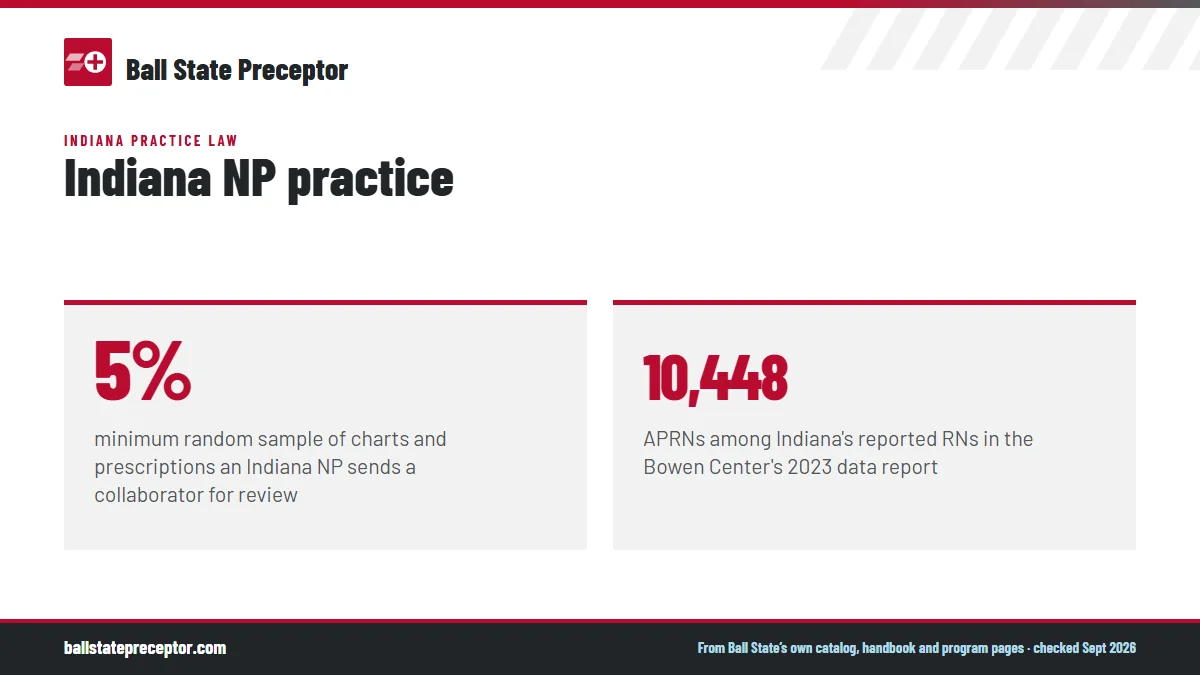
- A review routine: within seven days, the NP sends the collaborator documentation of prescribing practices, including a random sample of at least 5% of charts and the medications prescribed
Two more rules keep the agreement tied to current licenses. It ends automatically if either clinician stops holding an active, unrestricted license, and the NP must always have an active agreement recorded with the Professional Licensing Agency (PLA). Agreements are filed in MyLicense One through its Change Collaborator/CPA feature, and the PLA offers a standard agreement form that supports electronic signature.
Prescribing inside an agreement
Indiana treats the APRN license as prescribing authority. The PLA is explicit that holding it does not by itself license anyone to work as an NP, and NPs who skip prescribing can practice on an RN license, whether Indiana-issued or a compact license from another state. The application itself, from pharmacology coursework to national certification, is laid out on the Indiana Board of Nursing page.
Once granted, the authority stays conditional. Without an active agreement on file, the PLA moves the APRN license and any controlled substance registrations to Current/Not Practicing status, and the NP may not prescribe until the license is active again. Controlled substances need two registrations on top of the license: Indiana's controlled substance registration and a federal DEA registration.
For a student with an Indiana NP preceptor, that means every prescribing decision in clinic runs through two sets of limits: your preceptor's and those of the preceptor's collaborating practitioner. The practice's patient mix and its collaborator's field shape what you will see across a semester.
The 2026 bills that did not pass
The 2026 General Assembly session brought another attempt to end the agreement requirement. Senate Bill 60 and House Bill 1129 would each have removed it. The Indiana Association of Clinical Nurse Specialists reported on February 6, 2026 that neither bill advanced out of committee.
The practical result is simple: the collaboration requirement stands in 2026. A Ball State student finishing the FNP in the 2026-27 year who plans to prescribe in Indiana should expect to file an agreement. If the law changes in a later session, the change will show up in the Indiana Code and on the PLA's licensing pages, which are the places to check before you apply.
What the rules mean for your preceptor search
Indiana law does not say who has to secure a preceptor for an NP student, and the state's written preceptor rules address pre-licensure programs, not graduate ones. Who may precept a Ball State FNP course is set by Ball State: its preceptor qualifications are in the clinical packet that admitted students reach through Canvas, and the preceptor requirements guide sets out the public part. Indiana's practice rules still shape the search in real ways:
- Every Indiana NP who prescribes does so under an agreement, so a practice's collaborating practitioner sets the outer edge of what that clinic treats and prescribes.
- A practice that loses its collaborator can see its NPs unable to prescribe until a new agreement is filed, which can unsettle a rotation midway through a course.
- The pool is large. The Bowen Center's 2023 RN and APRN data report counted 10,448 APRNs among 72,447 reported Indiana RNs, with 86.5% in the nurse practitioner role and primary care the most reported specialty.
- Health systems add rules of their own. IU Health accepts only students whose primary residence and nursing licensure are in Indiana and bars students from reaching out to its providers on their own, while Community Health Network lists Ball State nursing among its affiliated schools.
How we find Indiana preceptors who fit
We search Indiana with the course in hand: family practice for NUR 681 and NUR 683, a women's health setting for NUR 684, a clinic that treats children for NUR 682, and a practice with enough volume for the 180 hours of NUR 673. Before we put a name in front of you, we confirm the preceptor's license is active and unrestricted, ask how the practice's collaboration is arranged, and check the site against Ball State's own limits, such as the rule against clinicals in your own unit or clinic.
You then receive everything your clinical packet and Ball State's standard affiliation agreement call for, a semester or more ahead, with a backup practice in view. Our regional guides for east-central Indiana and the Indianapolis metro show the systems near you. Send your course and county through the request form.
Questions Ball State students ask
Do Indiana nurse practitioners have full practice authority?
No. AANP lists Indiana as reduced practice because prescribing depends on a practice agreement with a collaborating practitioner. The 2026 session's bills to remove that condition, SB 60 and HB 1129, stayed in committee, so new Ball State graduates who want to prescribe in Indiana should plan on an agreement.
Can a physician precept a Ball State FNP student in Indiana?
Indiana law does not settle that for NP students. Ball State keeps its FNP preceptor qualifications in the clinical packets, which only enrolled students can open in Canvas, so check with your course faculty first when you plan to approach a physician or another clinician who is not an NP.
Does my Indiana preceptor need any special credential to precept?
Indiana's written rules on clinical preceptors, including the three years of RN experience, are aimed at pre-licensure programs. For your FNP courses, the qualifications that apply are Ball State's, set out in the clinical packet, plus whatever the clinical site requires of its own staff.
What happens to an Indiana practice agreement when an NP changes jobs?
The agreement belongs to a specific collaborating practitioner, so a new collaborator means updating the record in MyLicense One through the Change Collaborator/CPA feature. If no active agreement remains on record, the APRN license drops to Current/Not Practicing status.
Does Indiana law require Ball State to find my preceptor?
No. Indiana's statutes and Board rules set standards for pre-licensure clinical placements but do not assign preceptor searches for APRN students. Ball State's own rule governs: FNP students secure their own preceptors, and faculty step in to support them if problems come up, as finding your own preceptor explains.
Related pages
Last checked 2026-09-26
We check these pages against Ball State's own catalog, graduate handbook, program pages and State Authorization Map, and Indiana rules. Your course faculty, your advisor and the Graduate Clinical Placement Coordinator have the final word.
Ball State asks you to find your preceptor. We find one near you.
Tell us your Ball State track, where you live and when your next clinical course starts. We find preceptors near you who fit the course, confirm the practice will sign Ball State's affiliation agreement, and line up a backup, so the School of Nursing can clear the site before the semester.
- Preceptors matched to the course: pediatrics for
NUR 682, women's health forNUR 684, adult primary care forNUR 681andNUR 683 - Outside your own unit or clinic, in a state where Ball State's program is authorized
- Across Indiana, from Muncie to Evansville, and in the other states Ball State accepts
Start your placement plan
Program, city and start date is all we need to begin.