No preceptor and a Ball State clinical course coming up: what to do this week
Tell your course faculty and the Graduate Clinical Placement Coordinator now, not in the week the course opens. Then widen the search inside a state authorized for your program, steer any willing practice toward Ball State's standard affiliation agreement, and clear your American Data Bank record so nothing else holds you up. Our placement desk starts looking as soon as you send the form.
Clinical course close and no preceptor?
Send your course, its start date and your county. Your placement advisor starts the search and tells you plainly what the timing allows.
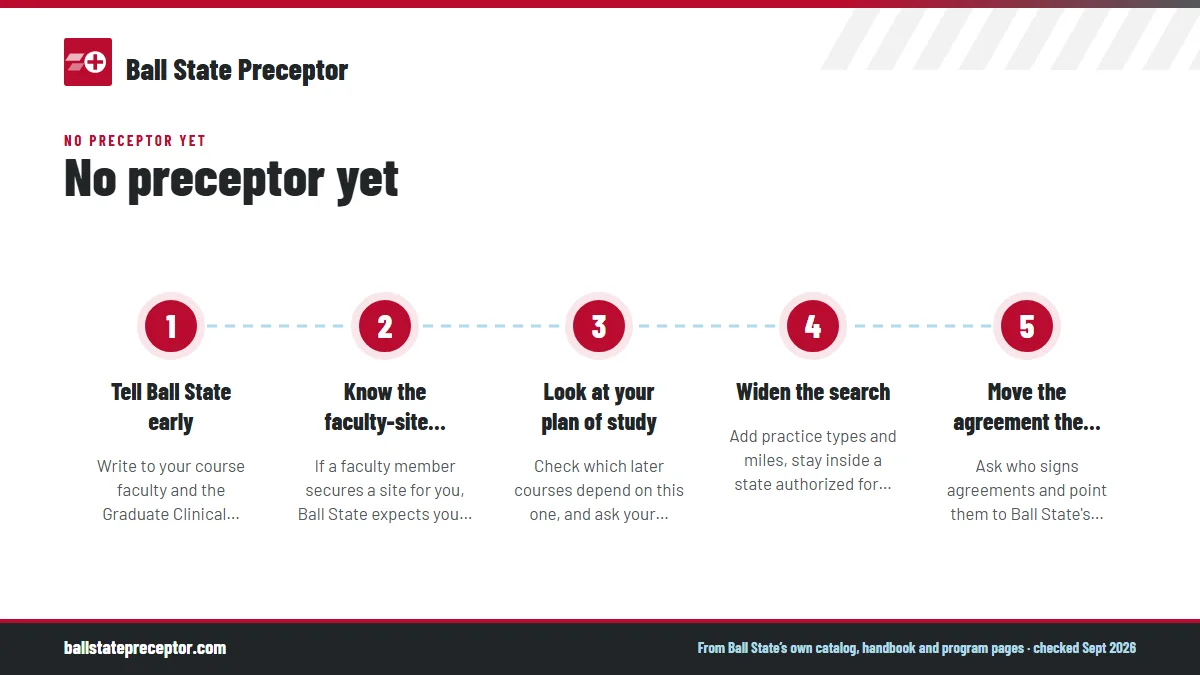
Six moves for this week
Work through these in order. The first two take only an email and a decision, and they shape everything after.
- Tell Ball State earlyWrite to your course faculty and the Graduate Clinical Placement Coordinator from your BSU email. Name the course, its start date, who you have approached and what is still open. Faculty can only help with a problem they know about.
- Know the faculty-site rule before you askIf a faculty member secures a site for you, Ball State expects you to take it wherever it is, or wait for a later semester. Decide now how far you can drive each week.
- Look at your plan of studyCheck which later courses depend on this one, and ask your advisor what shifts if it moves.
- Widen the searchAdd practice types and miles, stay inside a state authorized for your program, and use each large system's formal channel instead of calling its clinicians.
- Move the agreement the day someone says yesAsk who signs agreements and point them to Ball State's standard version at once.
- Clear your ADB record nowRenew anything that lapses before or during the course. ADB may need up to five business days to approve an upload, and the School does not hurry that review.
Why telling faculty early matters
It can feel like admitting defeat, but an early message is exactly what Ball State's process expects. The MS FAQ pairs the student's active role in securing placements with faculty who are available when problems come up, and the graduate handbook sends preceptor and clinical-hour questions to course faculty. When you are unsure who handles something, the handbook points you to the Graduate Clinical Placement Coordinator.
Early notice buys options. Faculty can say whether a different practice type suits the course, whether a site you are weighing fits, and what a delay would mean for your plan. Two weeks before the term, there is room for very little of that.
A site found by faculty comes with a condition: accept it, even if it is farther than you hoped, or wait for a future semester. Know your travel limit before you ask.
What a missed start can cost
Ball State builds each graduate plan of study around the courses offered each term, and the handbook warns that stepping off the plan can leave some courses two or three semesters away. The FNP courses chain together: NUR 634 leads into the primary care courses, NUR 683 follows a passing grade in NUR 681, and NUR 673 waits until everything else in the concentration is done.
A course pushed back can move your graduation, and every extra term counts against the six calendar years Ball State allows for a master's degree, or five for a certificate. The grades and time limits page covers those rules in full. A search that starts this week is worth more than a perfect one that starts next month.
Widening the search without breaking a rule
A wider net is the quickest route to a yes, as long as every new site still passes Ball State's checks.
- More practice types: family practice, internal medicine and community health centers for the adult courses, pediatric practices for
NUR 682, and OB-GYN or women's health clinics forNUR 684. FNP clinicals belong in primary care or clinic settings, so check anything unusual with course faculty. - More miles: a longer drive once a week often makes the difference, and Ball State's catalog notes that clinical travel costs are yours.
- The right state: you must live in, and complete every hour in, a state authorized for your program, so a practice across a state line works only if that state is authorized too. See clinicals outside Indiana.
- Not your own unit or clinic, however convenient it would be.
- Not an excluded system: Ball State names health systems it will not contract with in several states, listed on the clinical agencies by state page.
- Formal channels at the big systems: IU Health, Beacon and Community each run their own application with deadlines months ahead, and each asks students not to cold-call clinicians. Their spring deadlines fall on or before September 1, so a late spring search usually runs through independent practices and community clinics.
The agreement timeline when time is short
Ball State's usual advice is to start arrangements with the agency about a semester ahead, so a late yes needs the paperwork handled fast. Three habits help. Ask the practice to sign the standard Ball State affiliation agreement rather than its own, since Ball State warns an agency's contract can slow approval considerably. Learn on the first call who signs, because a practice manager and a system's legal office move at very different speeds. And allow for the mail: Ball State accepts only original signed documents, never scans, faxes or photos.
Keep a second practice warm while the first agreement moves. Ball State recommends a backup agency every semester, and in a late search the backup is often the one that gets there first. The affiliation agreement guide covers the rest.
How our placement desk helps right away
Send us your course, its start date, your county and where you work, and your placement advisor starts at once. We check Ball State's rules first, then approach several practices that suit the course in parallel rather than one call at a time, and tell you plainly whether the timing points to this term or the next.
When a preceptor agrees, you get the name, the setting, the person who signs the agreement and a backup, plus the details your clinical packet forms will ask for. Your course faculty and the School of Nursing still clear the site. Already in a course and short on hours? See behind on clinical hours.
Questions Ball State students ask
Will Ball State find me a preceptor if I cannot find one?
Ball State asks FNP students to find their own preceptors, with faculty support when issues arise. Sometimes a faculty member does secure a site, and the MS FAQ then says you must accept it or wait for a future semester. Treat that as a safety net rather than a plan, and keep searching while you talk to faculty.
Can I drop a Ball State clinical course if I have no preceptor?
The catalog lets you withdraw through 60% of a course's scheduled length, and the nursing handbook asks you to tell the Clinical Placement Coordinator and your course faculty within three days of a drop or withdrawal. Talk to your advisor first, because leaving the plan of study can delay later courses by two or three semesters.
Can I do clinical hours in another state if nothing is available near me?
Only in a state where Ball State is authorized for your program, and you must also live in an authorized state. For the MS in Nursing that means Indiana plus 25 other jurisdictions; the post-master's certificate and the DNP have shorter lists. Confirm any cross-border site with course faculty before the agency signs anything.
Can my employer's other clinic be my site?
Not your own unit or clinic: Ball State's MS FAQ rules that out for clinicals. Another clinic in the same organization, with a preceptor you do not report to, may be possible. The workplace guide walks through the gray areas, and your course faculty make the final call.
How quickly can a placement service find a preceptor?
It depends on the course, your county and how close the term is, because the agreement still needs time after the preceptor's yes. We begin as soon as you send the form, work several practices at once, and tell you early if the next term is the realistic target.
Related pages
Last checked 2026-09-26
We check these pages against Ball State's own catalog, graduate handbook, program pages and State Authorization Map, and Indiana rules. Your course faculty, your advisor and the Graduate Clinical Placement Coordinator have the final word.
Ball State asks you to find your preceptor. We find one near you.
Tell us your Ball State track, where you live and when your next clinical course starts. We find preceptors near you who fit the course, confirm the practice will sign Ball State's affiliation agreement, and line up a backup, so the School of Nursing can clear the site before the semester.
- Preceptors matched to the course: pediatrics for
NUR 682, women's health forNUR 684, adult primary care forNUR 681andNUR 683 - Outside your own unit or clinic, in a state where Ball State's program is authorized
- Across Indiana, from Muncie to Evansville, and in the other states Ball State accepts
Start your placement plan
Program, city and start date is all we need to begin.