Grades, Incompletes and time limits in Ball State's graduate nursing programs
The School of Nursing sets a higher bar than the university default: B is the lowest passing grade in a NUR course, clinical performance is rated satisfactory or unsatisfactory, and an Incomplete in an NP clinical course keeps you out of the next one. Add the six-year limit on the master's, the inactivity rules and a plan of study that can slip two or three semesters, and a late preceptor turns into an academic problem as well as a scheduling one.
Get your placement plan
Tell us your Ball State program and where you live. A placement advisor replies with preceptor and site options in your community that fit your Ball State course.
The grade floor: B in every NUR course
The 2026-27 Graduate Catalog sets a university minimum: no course graded below 2.0, meaning C- or lower, counts toward any degree, and individual departments may set a higher bar. The School of Nursing does. Its graduate handbook makes B the minimum passing grade for NUR courses and says no course below a B (3.0) counts toward a nursing degree.
On the School's scale, an A runs from 93 to 100, a B from 83 to 85.9, and 74 or below is an F. Two more handbook rules raise the stakes: a course may be repeated only once, and a student may fail only one course, clinical or didactic. A second failure brings dismissal from the program.
Some grades stay out of your GPA entirely. The catalog lists W (Withdrawal), I (Incomplete), AU (Audit) and EC (Enrollment Continued) as excluded, without defining EC. It lists no In Progress grade, so plan on an unfinished clinical course ending the term either graded or as an Incomplete.
How clinical performance is graded
Clinical work is judged on its own terms. The handbook says course faculty and preceptors evaluate students in clinical settings, joined in certain states by a clinical supervisor, and that the result is satisfactory or unsatisfactory. An unsatisfactory clinical evaluation means an F for the course, no matter how well the exams and papers went.
The evaluation forms themselves, one for the student and one for the preceptor, sit in the clinical packet in the Nursing Grad Students Canvas Community. Read them before your first clinical day so you know what your preceptor will be asked to rate, and share them with the preceptor early.
Compliance can fail a course too. Each clinical course carries a Compliance Expectations grade that starts at 20 points and loses 4 for every noncompliant week. Hours completed while you are noncompliant must be repeated, and being out of compliance during any part of a week more than four times in a semester is an automatic clinical failure. The clinical compliance requirements guide lists every item that can trip this rule.
Incompletes, and why they block the next clinical course
An Incomplete is not a routine extension. The graduate handbook limits it to extenuating circumstances, with the course instructor, in consultation with the School Director, deciding whether the reason is valid. You and the instructor sign a written agreement covering the unfinished work, and anything left undone turns the grade into an F.
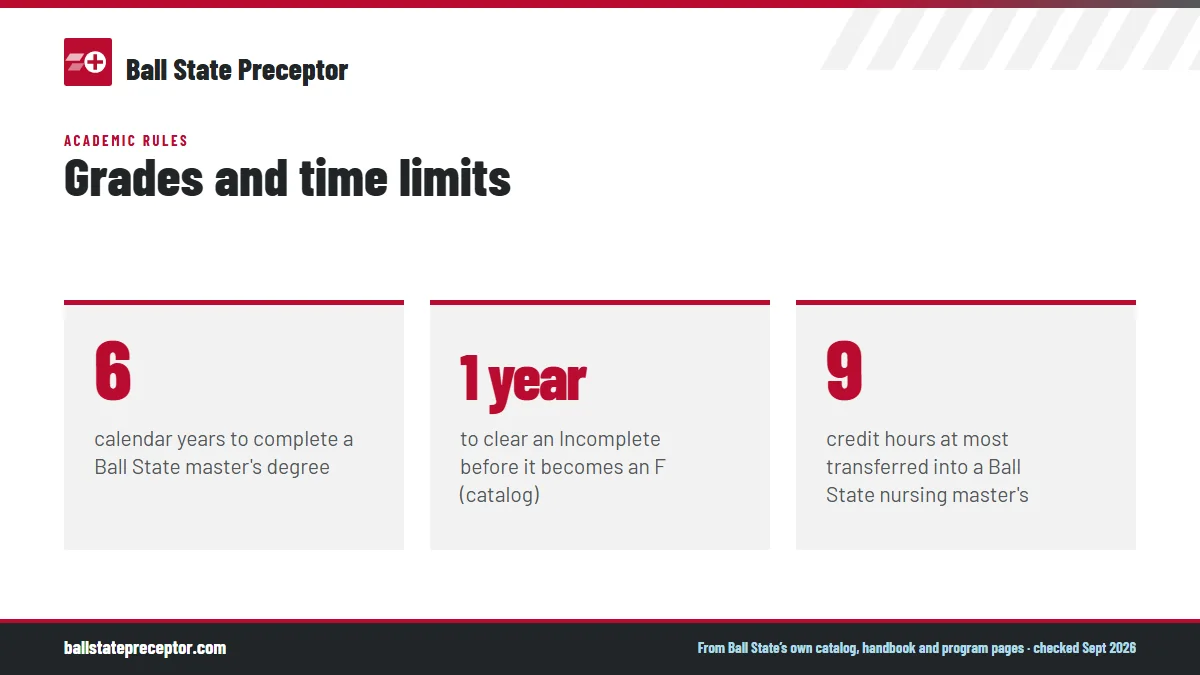
The catalog sets the outer limit. You have up to one year to clear an I, after which it converts to an F automatically, although the dean of the Graduate School may approve up to one more year on written notice to the registrar.
For nurse practitioner students the bigger issue is sequence. An Incomplete in NUR 634, NUR 681, NUR 682, NUR 683 or NUR 684 has to be finished with a passing grade before you may take another NP clinical course, and the handbook applies the same principle to clinical courses in general. Because the FNP clinicals run back to back, one open Incomplete can stall the whole chain.
Most clinical Incompletes start with the preceptor, not the coursework: a preceptor confirmed late, clinical days cut short or a site that pulls out mid-term leaves hours missing when the part of term ends. The strongest protection is the one Ball State already recommends, a confirmed preceptor well before the term and a backup agency for every semester.
When you fall off the plan of study
Graduate plans of study at Ball State are individual and tentative, because not every course runs every semester. The graduate handbook is direct about the risk: students who do not follow the plan exactly as outlined should expect it may be two or three semesters before they can take certain classes, which can push back graduation.
Clinical courses are where that usually happens. If NUR 682 cannot start because no preceptor is confirmed, or NUR 681 ends with an Incomplete, the next opening in that course may be a term or more away. The MS FAQ adds a related rule: when a faculty member helps secure a site, you must accept it or wait for a future semester.
Each lost term also runs down the program clock described below. The FNP clinical hours guide shows how tightly the six FNP clinical courses are linked, and the academic calendar shows when each 2026-27 term and session begins.
Time limits and inactivity
Every Ball State graduate program runs on a clock, and the School of Nursing adds its own inactivity rule on top of the university's.
| Rule | Limit | What happens |
|---|---|---|
| Master's degree | Six calendar years | Students who pass the limit are academically separated from the program |
| Graduate certificate | Five years | All certificate requirements must be met within the limit |
| Doctoral degree (DNP) | Seven calendar years | Limited one-year extensions are possible |
| University inactivity | Three consecutive semesters with no courses | You become inactive in the BSU system |
| School of Nursing inactivity | Three semesters without completing a nursing course | Your health clearance account is archived and you petition the GAP Committee |
| Leave of absence | Up to two consecutive semesters | No petition needed |
Coursework that has aged past the limit can sometimes be revalidated, but transfer work cannot. If you need a break, a planned leave of absence keeps you inside the rules: the form is in the Nursing Grad Students Canvas Community and goes to the Clinical Placement Coordinator. Travel nurses on a contract in a state where Ball State is not authorized use the same leave, capped at two consecutive semesters.
Transfer credit
Transfer credit into Ball State's graduate programs is narrow. Only graduate courses with a grade of B or better qualify, and a B- does not transfer. The catalog allows up to nine transfer credits toward a master's program of 44 or fewer credits and none toward a certificate.
The graduate nursing handbook adds three conditions of its own: nine credit hours at most, no course already used toward another master's degree, and nothing taken after you first enroll at Ball State unless the Graduate Programs Director approves it in advance. The DOSL Advisor for Nursing Graduate Students handles transfer requests, so raise them before your plan of study is set rather than after.
Clinical courses deserve particular care. Certificate students, for example, may be required after a transcript review to add courses such as NUR 632, NUR 634 and NUR 638, and NUR 634 brings 60 clinical hours and one more preceptor to find.
Keeping your clinical courses on schedule
Most rules on this page bite hardest when a clinical course goes wrong: an Incomplete that blocks the next course, a term lost from the plan of study, a semester that counts against the six-year limit. Ball State's own advice for avoiding that is to start planning clinicals a year ahead and keep a backup agency every semester, and that advice sits at the center of how we work.
Your placement advisor finds a preceptor who fits the exact course and its hours, checks the site against Ball State's rules, prepares what the affiliation agreement and clinical packet need, and keeps a second option ready. If a preceptor drops partway through, we move straight to a replacement so your hours keep moving. Already short on hours? Start with behind on clinical hours, then send us your course and term.
Questions Ball State students ask
Is an Incomplete the same as failing a Ball State nursing course?
No. An I stays out of your GPA while you finish the agreed work, but the catalog turns it into an F automatically if it is not cleared within the agreed time, one year at most unless the Graduate School dean extends it. In an NP clinical course it also keeps you out of the next clinical course until it is resolved.
Can I retake a failed NUR course at Ball State?
Once. The graduate handbook allows a course to be repeated one time, and it allows only one failed course in the whole program, clinical or didactic. A second failure leads to dismissal, which is why an unsatisfactory clinical evaluation, which means an F for the course, carries so much weight.
Does a C count in Ball State's MS in Nursing?
Not in a nursing course. The School of Nursing requires at least a B in every NUR course and does not count lower grades toward a nursing degree. The university-wide floor of 2.0 applies to other courses, but the School's own rule is the stricter one for your concentration.
What happens if I skip a semester in Ball State's nursing program?
A leave of absence of up to two consecutive semesters needs no petition. Go three semesters without finishing a nursing course and the School archives your health clearance account, and you must petition the GAP Committee to continue. Three consecutive semesters with no courses at all also makes you inactive at the university.
Can I transfer graduate nursing courses from another school to Ball State?
Possibly, within limits. Courses must be graduate level with a grade of B or better, nine credit hours at most, and not already counted toward another master's degree. Courses taken elsewhere after you enroll at Ball State need advance approval from the Graduate Programs Director. No transfer credit counts toward a certificate.
Related pages
Last checked 2026-09-26
We check these pages against Ball State's own catalog, graduate handbook, program pages and State Authorization Map, and Indiana rules. Your course faculty, your advisor and the Graduate Clinical Placement Coordinator have the final word.
Ball State asks you to find your preceptor. We find one near you.
Tell us your Ball State track, where you live and when your next clinical course starts. We find preceptors near you who fit the course, confirm the practice will sign Ball State's affiliation agreement, and line up a backup, so the School of Nursing can clear the site before the semester.
- Preceptors matched to the course: pediatrics for
NUR 682, women's health forNUR 684, adult primary care forNUR 681andNUR 683 - Outside your own unit or clinic, in a state where Ball State's program is authorized
- Across Indiana, from Muncie to Evansville, and in the other states Ball State accepts
Start your placement plan
Program, city and start date is all we need to begin.