Ball State clinical compliance requirements, item by item
Before a Ball State graduate student logs a single clinical hour, a long list has to be approved in American Data Bank: vaccines, TB testing, a 10-panel drug screen, a background check, OSHA and HIPAA training, health insurance, an American Heart Association CPR card and your RN license. Some items return every semester and several every year, the student pays every cost, and each clinical site can add requirements of its own or decline a student.
Arrive at your first clinical day already cleared
Share your next Ball State course and start date. We find the preceptor and check what the site adds to Ball State's list.
The full list from the Graduate Nursing Handbook
This list follows the Health Clearance + Compliance section of the Graduate Nursing Handbook 2025-26, which is still the edition Ball State links in September 2026. Every item goes into American Data Bank and counts only after ADB approves it.
| Requirement | What Ball State asks for | When it comes due |
|---|---|---|
| MMR | Documentation for measles, mumps and rubella | On acceptance |
| Hepatitis B | The vaccine record or a declination | On acceptance |
| Varicella | Documentation | On acceptance |
| Tdap | A dose within the last ten years | On acceptance |
| COVID-19 | Vaccination or a declination | On acceptance |
| Tuberculosis | A 2-step TB skin test, QuantiFERON or T-Spot, plus a TB questionnaire | On acceptance and yearly; questionnaire every semester |
| Influenza | The influenza form or a declination | On acceptance and yearly |
| Drug screen | A 10-panel urine drug screen | On acceptance and yearly |
| Background check | Background check results | On acceptance and yearly |
| OSHA and HIPAA | Completed OSHA and HIPAA training | On acceptance and yearly |
| Health insurance | Personal health insurance documentation | On acceptance and yearly |
| CPR | A 2-year AHA BLS Healthcare Provider card or a two-year AHA ACLS card | On acceptance; keep it unexpired |
| RN license | License documentation showing the license number and expiration date | On acceptance; update after a renewal or a move |
| Consent form | The Semesterly Informed Consent, Disclosure, and Contact Information Form | Every semester |
The handbook closes the list with a catch-all: students must also meet any additional requirements a clinical site establishes. It also declines to rank the items, so an unsigned consent form stalls your hours as surely as an expired background check.
Items that come back, and how to plan around them
Most of the work after admission is renewal. Two items return every semester, the consent form and the TB questionnaire. Six return every year: the drug screen, the background check, OSHA and HIPAA training, proof of health insurance, TB testing and the flu form. Your CPR card and your RN license keep their own expiration dates.
Put every date on one calendar and lay it over your plan of study. A yearly renewal that falls in the middle of NUR 673, the 180-hour practicum that runs about 1.5 to 2 days a week, is harder to absorb than one that lands between terms. Renewing a few weeks early to move a date off a heavy clinical stretch is often worth the effort. The clinical hours planner shows which of your courses carry hours and when.
The 10-panel drug screen
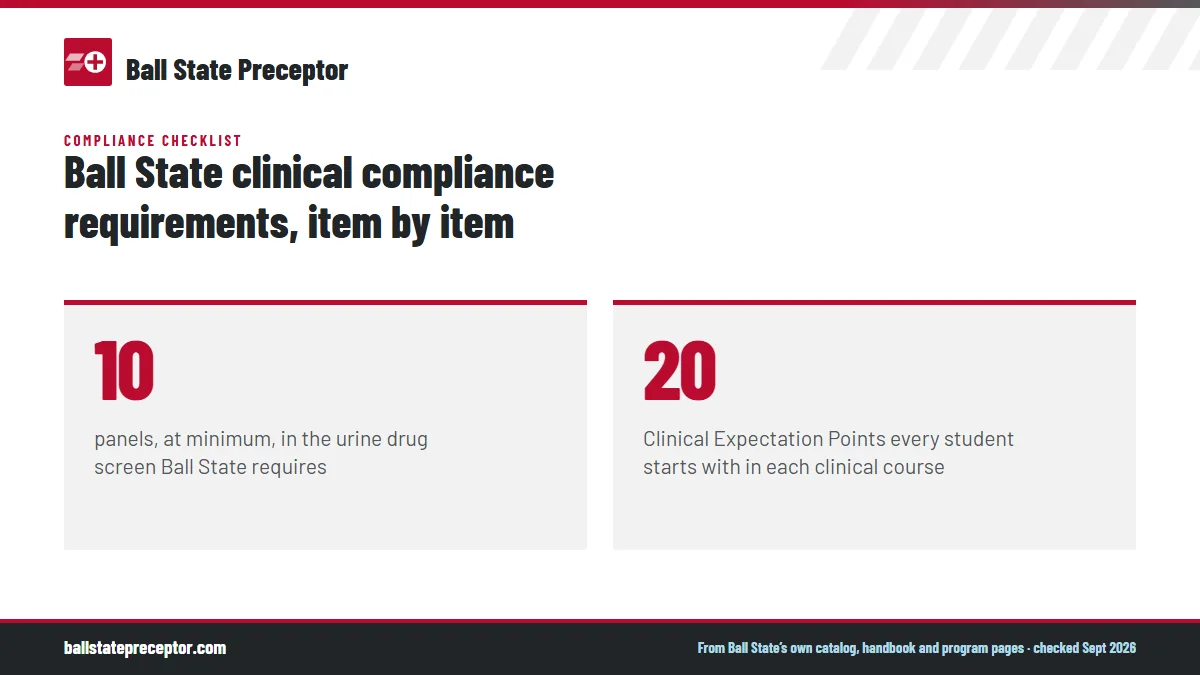
Ball State requires at least a 10-panel urine drug screen before a nursing student takes part at any clinical site, and again every year after. The policy reads cannabis broadly: THC covers every product that may contain it, and the handbook names marijuana, CBD and oils. A product sold legally where you live can still produce a result that halts your clinicals.
A positive result keeps you out of clinical sites and starts a waiting period of at least six months, along with required treatment, before you may return. The policy explains the stakes in its opening: Ball State holds contracts with clinical agencies so students can train with them, and those agencies have the right to refuse any student. The Nursing Compliance Coordinator administers the policy, and every cost of screening under it is yours.
Clinical sites can add to the list, or say no
Ball State's list is the minimum a site will see. The handbook tells students to comply with any further requirements a clinical site sets, and larger health systems often run their own student onboarding on top of the school's clearance, with their own forms, modules and dates.
The other half of the rule is blunt: clinical sites have the right to refuse any student for clinical placement. A background check finding, a missing vaccine or an expired card can end a placement even where Ball State has an agreement with the agency. Some systems also set eligibility rules of their own. IU Health's student page, for example, admits only students whose primary residence and nursing license are both in Indiana, which is IU Health's rule rather than Ball State's.
Ask each agency what it requires before you commit to it, get the answer in writing where you can, and keep a second agency in view, as Ball State's guidance on affiliation agreements recommends for every semester.
Clinical Expectation Points and the other sanctions
Every graduate clinical course includes a graded assignment for Compliance Expectations. Each student starts the semester with 20 points in every class and loses 4 points for each week of noncompliance. Those are Ball State's Clinical Expectation Points, and they sit alongside heavier consequences:
- No clinical hours accumulate while you are noncompliant, and hours done during that time are repeated.
- Once clinical hours have begun for the semester, being out of compliance during any part of a week more than four times that semester brings an automatic clinical failure of the course.
- A second failed course, clinical or didactic, means dismissal from the program.
- Noncompliance makes you ineligible for School of Nursing-awarded scholarships in the following academic year.
- A sanction lifts when you show your course faculty proof from ADB: its approval email or a screenshot of a fully compliant dashboard.
- Appeals go to the Graduate Admission and Progression (GAP) Committee within three days.
The four-strike rule counts any part of a week. A document that lapses on a Tuesday and clears on Thursday is still one strike, and more than four strikes in a semester means an automatic clinical failure.
What compliance costs, in plain terms
The handbook places every fee and cost tied to health clearance and compliance on the student, and says the School of Nursing will not reimburse any of it. That covers the screens, tests, vaccines, CPR course and training the list demands, and the drug screen policy repeats the point for screening. Personal health insurance is itself a requirement, so its premium is part of the picture.
Those costs sit next to the clinical course fee Ball State charges on each graduate clinical course, which comes with a small insurance charge, and the travel costs the catalog assigns to students for reaching clinical sites. Because much of the list renews every year, budget for clearance across the whole program rather than the first semester alone. Ball State's online fees page shows the current course fees.
How we help you arrive cleared
Every placement we arrange for a Ball State course comes with a clearance check. Before we confirm a site, we learn what the agency requires beyond Ball State's list, compare it with the expiration dates you share from your ADB dashboard, and flag anything due to lapse before the course ends. You get one list, in date order, of what to renew and when.
That way your preceptor, your agreement paperwork and your clearance all arrive together on the first clinical day. If a renewal would land in the middle of a rotation, you hear from us early enough to move it forward. If a site turns out to need something that cannot be ready in time, we switch to the backup site before the term starts, not after. See how it works or start with the placement request form.
Questions Ball State students ask
Can I use an ACLS card instead of BLS for Ball State clinicals?
Yes, if the American Heart Association issued it. The handbook accepts a 2-year AHA BLS Healthcare Provider CPR certification or a two-year AHA ACLS certification. Because it names the AHA specifically, check the issuer on your card before you upload it to ADB.
Does Ball State accept a declination for the flu or COVID-19 vaccine?
Ball State's own list allows a declination for COVID-19, for influenza and for hepatitis B. A clinical site can still set a stricter rule, and the handbook tells students to meet whatever a site adds, so confirm with the agency before you rely on a declination for that rotation.
Do Ball State graduate students need a physical exam?
The graduate list in the handbook does not include one. The bachelor's handbook adds a physical exam and an N95 form for BSN students, and the undergraduate catalog adds Medicare and Medicaid exclusion screenings. A clinical agency can still ask graduate students for a physical as part of its own onboarding.
Does Ball State carry liability insurance for graduate clinicals?
The graduate handbook does not address it. The bachelor's handbook says BSN students in clinicals are covered by Ball State's professional liability policy, and Ball State's fees page lists a small insurance charge with each graduate clinical course. If a site asks for proof of coverage, ask your course faculty or the compliance coordinator.
What if a clinical site turns me down after my background check?
The handbook confirms that sites may refuse any student. Tell your course faculty and the Graduate Clinical Placement Coordinator right away, since a replacement site needs its own agreement and lead time. This is why Ball State urges a backup agency every semester, and why we line one up with every placement.
Are the rules different for DNP or certificate students?
The Graduate Nursing Handbook covers the master's, the post-master's certificate and the DNP, and its compliance section applies across them. DNP students also need all clinical clearance documents in place, along with the agency agreement and practicum mentor agreement, before their project can be implemented.
Related pages
Last checked 2026-09-26
We check these pages against Ball State's own catalog, graduate handbook, program pages and State Authorization Map, and Indiana rules. Your course faculty, your advisor and the Graduate Clinical Placement Coordinator have the final word.
Ball State asks you to find your preceptor. We find one near you.
Tell us your Ball State track, where you live and when your next clinical course starts. We find preceptors near you who fit the course, confirm the practice will sign Ball State's affiliation agreement, and line up a backup, so the School of Nursing can clear the site before the semester.
- Preceptors matched to the course: pediatrics for
NUR 682, women's health forNUR 684, adult primary care forNUR 681andNUR 683 - Outside your own unit or clinic, in a state where Ball State's program is authorized
- Across Indiana, from Muncie to Evansville, and in the other states Ball State accepts
Start your placement plan
Program, city and start date is all we need to begin.