Ball State's clinical placement process, in the order it happens
A Ball State graduate clinical course begins long before its first class. You plan about a year out, line up a preceptor, get the agency to sign Ball State's affiliation agreement, work through the clinical packet and American Data Bank clearance, and let course faculty and School of Nursing staff clear the site before any hours count. This guide walks the route stage by stage and links to the page that covers each one in depth.
Get your placement plan
Tell us your Ball State program and where you live. A placement advisor replies with preceptor and site options in your community that fit your Ball State course.
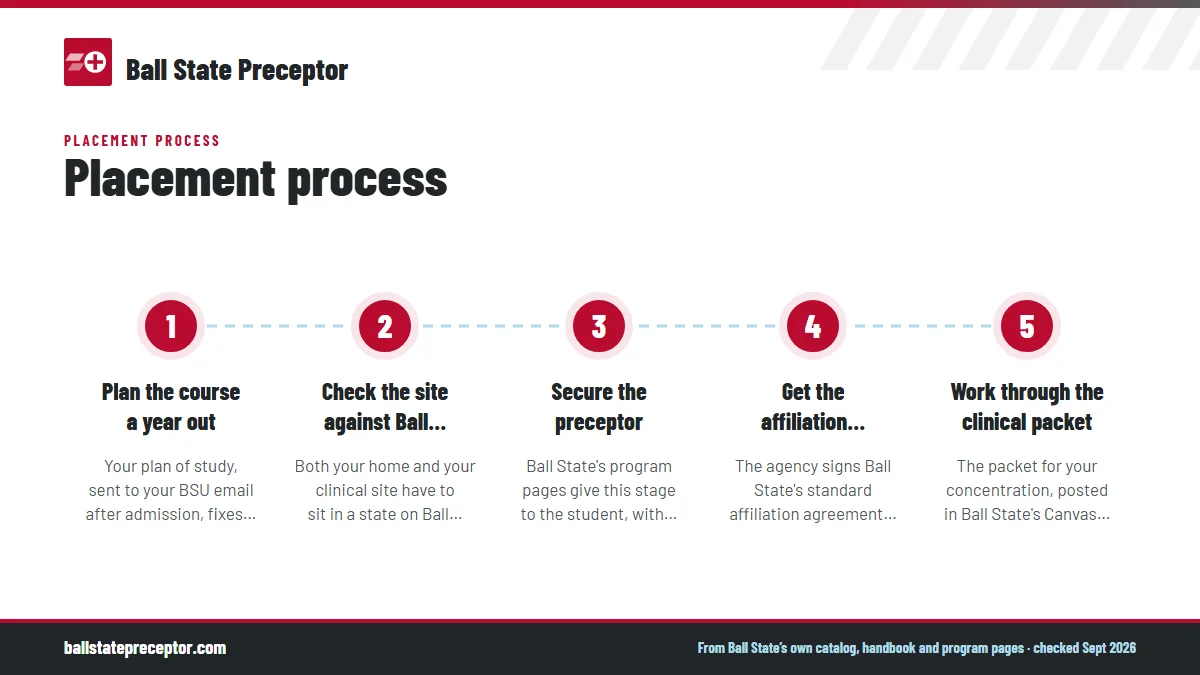
The eight stages, start to finish
Ball State publishes no single flowchart for graduate placements; this sequence combines the Graduate Nursing Handbook 2025-26, the School's agency agreement guidelines and the online program pages. The stages overlap, but each leans on the one before.
- Plan the course a year outYour plan of study, sent to your BSU email after admission, fixes the semester of each clinical course. The handbook asks you to start planning at least a year before each one. Exact wording: finding your own preceptor.
- Check the site against Ball State's rulesBoth your home and your clinical site have to sit in a state on Ball State's authorized list for your program. FNP clinicals belong in primary care or a clinic, not your own unit or clinic.
- Secure the preceptorBall State's program pages give this stage to the student, with faculty support if problems arise. Look for a preceptor who fits the course and has room in your semester.
- Get the affiliation agreement signedThe agency signs Ball State's standard affiliation agreement about a semester before the course, and only the original signed copy counts. Keep a backup agency in view. See affiliation agreements.
- Work through the clinical packetThe packet for your concentration, posted in Ball State's Canvas Community for graduate nursing students, sets out forms, preceptor qualifications and due dates. See clinical packets.
- Clear American Data Bank and link COREHealth clearance runs through American Data Bank, which you link to a CORE account in your first clinical semester. See American Data Bank and CORE.
- Faculty and staff reviewCourse faculty and School of Nursing staff look over the site, the paperwork and your clearance, and registration opens by permission.
- Complete and record the hoursYou work the hours with your preceptor, record them on the packet's time sheet and stay compliant all term. Hours per course are on the clinical hours planner.
Two clocks: the preceptor year and the agreement semester
Ball State gives two lead times, and they measure different jobs. The handbook's one-year advice is about finding a preceptor and site before other students claim them. The Current Student Resources page's semester-ahead advice is about the agency's contract, which needs time for review and signatures.
Taken together, the year buys you a willing preceptor and the semester gets the contract through. The precise paperwork deadlines for each course appear on no public Ball State page; they sit in the clinical packet, so check the packet before relying on any outside timeline, this one included.
| When | What happens | Who moves it |
|---|---|---|
| A year or more ahead | Search for a preceptor who fits the course and your state | You |
| About a semester ahead | The agency reviews and signs Ball State's standard affiliation agreement; a backup agency is identified | The agency, Ball State and you |
| After orientation | Your concentration's clinical packet opens in Canvas | You read and follow it |
| First clinical semester | Your American Data Bank account is linked to CORE | You |
| Before each ADB renewal date | Updated items are reviewed, which can take three to five business days | You and American Data Bank |
| Course start | Registration permission, clinical paperwork and preceptor onboarding are in place, and hours begin | SON staff, course faculty and you |
The year and the semester are not competing deadlines. Start the preceptor search at the one-year mark and the agreement at the one-semester mark.
How the route changes by program
The same stages run through every Ball State graduate program, but the details shift with the program you are in.
- MS in Nursing FNP: six clinical courses, starting with
NUR 634, running throughNUR 681toNUR 684and ending withNUR 673, each needing a site that suits its focus.NUR 681includes one 8-hour clinical day on campus in Muncie. - Post-Master's Certificate FNP: the same primary care courses, 390 to 690 hours depending on your prior degree, and a shorter list of eligible states. Ball State's own documents disagree on that list, so confirm your state before you search.
- Nurse Educator and Leadership and Management: one 180-hour practicum,
NUR 672, which may run at your own employer with an RN holding a master's or doctorate as your supervisor. - DNP: the project site needs your committee's confirmation no later than the opening of your
NUR 792term, and implementation waits on a signed agency agreement. More on DNP clinical hours. - BSN in Muncie: the School places students with agencies across east-central Indiana under faculty supervision, so the search stage falls away.
Where students lose time
Most delays trace back to a short list of predictable snags. Each one has a fix if you spot it early.
- The preceptor says yes, but the agency's legal office wants its own contract. Ball State warns that a non-Ball State agreement can stretch approval time considerably.
- The signed agreement arrives as a scan or a phone photo. Ball State takes originals only.
- An American Data Bank item lapses mid-semester. Noncompliant students cannot accumulate hours, and anything logged during that stretch has to be repeated.
- You move. A change of state starts a seven-day window to notify the Clinical Placement Coordinator, and the new state has to be authorized for your program. See clinicals outside Indiana.
- An Incomplete in an NP clinical course holds up the next NP clinical course until you pass it.
- You fall off your plan of study. The handbook cautions that some courses may then be two or three semesters away.
Who reviews the site before hours count
Ball State's public documents do not map the approval workflow step by step, but they do name who handles it. The SON Graduate Program and Compliance Coordinator covers submission of clinical paperwork, clinical placement and the onboarding information sent to preceptors. Course faculty answer questions about preceptors and hours and, alongside the preceptor, evaluate your clinical performance. The agency keeps a say too, since Ball State's handbook lets any site decline a student.
Nobody self-registers for a graduate nursing course: the School grants permission course by course from your plan of study and holds it back while any clearance item is outstanding. The who does what guide lists every role that touches a clinical course and what to ask each one.
Where our placement desk fits in
We take on the stage that swallows the most time: finding a preceptor who matches the exact Ball State course, in your authorized state, outside your own unit or clinic, at an agency ready to sign Ball State's standard agreement. We begin at least a term before the course, in step with Ball State's own advice, and keep a backup lined up so a late refusal does not cost you the term.
Then we hand you what the packet and agreement stages need: the preceptor's details for the forms, the agency contact who signs, and a schedule matched to your ADB renewal dates. Clearing each site remains the job of Ball State's course faculty and School of Nursing staff; our part is making sure what reaches them is complete and fits the course the first time. Tell us your next course in the form below.
Questions Ball State students ask
How long does the Ball State clinical placement process take?
Budget about a year per clinical course. Ball State's graduate handbook advises starting at least a year before the course, and the agency agreement alone needs roughly a semester. American Data Bank can take up to five business days at each renewal. A student who starts one or two months out risks having no approved site when the course opens.
Can I begin clinical hours before the affiliation agreement is signed?
Plan as if you cannot. Ball State links the agreement to approving a clinical placement, and for DNP projects an agency agreement must be in place before implementation begins. The exact start conditions for your course are in its clinical packet, so confirm them there or with your course faculty before booking a first shift.
Who submits my clinical paperwork to Ball State?
In the handbook's staff table, paperwork submission belongs to the SON Graduate Program and Compliance Coordinator, while your clinical packet sets the rules and dates. Meeting them is on you: the handbook makes following the rules for clinical forms, including agency contracts and evaluations, a condition of progressing in the program.
How are clinical hours tracked at Ball State?
Ball State's public pages name no hour-logging system. The clinical packet includes a clinical time sheet, and your American Data Bank account links to a CORE account during your first clinical semester. Ask your course faculty which record they grade from, and keep the time sheet current week by week.
Can one practice host more than one Ball State FNP course?
Ball State's FNP page allows 682 of the 690 hours in family practice primary care; the remaining 8 are the Muncie campus day. A family practice with the right patient mix may host several courses, but each course has its own focus, such as children in NUR 682, so confirm the fit with course faculty.
What if my preceptor drops out partway through a course?
Ball State advises keeping a backup agency every semester for exactly this, and its MS FAQ says faculty are available to support students when issues arise. Tell your course faculty quickly. If you work with us, the placement desk starts on a replacement that fits the same course the day you tell us.
Related pages
Last checked 2026-09-26
We check these pages against Ball State's own catalog, graduate handbook, program pages and State Authorization Map, and Indiana rules. Your course faculty, your advisor and the Graduate Clinical Placement Coordinator have the final word.
Ball State asks you to find your preceptor. We find one near you.
Tell us your Ball State track, where you live and when your next clinical course starts. We find preceptors near you who fit the course, confirm the practice will sign Ball State's affiliation agreement, and line up a backup, so the School of Nursing can clear the site before the semester.
- Preceptors matched to the course: pediatrics for
NUR 682, women's health forNUR 684, adult primary care forNUR 681andNUR 683 - Outside your own unit or clinic, in a state where Ball State's program is authorized
- Across Indiana, from Muncie to Evansville, and in the other states Ball State accepts
Start your placement plan
Program, city and start date is all we need to begin.