American Data Bank and CORE: staying cleared for Ball State clinicals
Ball State's School of Nursing checks every graduate student's health clearance through American Data Bank (ADB), and in your first clinical course you connect that account to a CORE account. Each ADB item has to be fully approved by its expiration date, ADB's review of an upload may run 3 to 5 business days, and the School will not shorten that window. Fall out of compliance and your clinical hours stop counting, so the calendar matters as much as the documents.
Keep your placement and your clearance on the same timeline
Tell us your next Ball State clinical course and when it starts. We line up the preceptor and flag every ADB date that could get in the way.
What American Data Bank does in Ball State's process
American Data Bank is the School of Nursing's health clearance and compliance vendor. Your immunization records, drug screen, background check, CPR card, RN license and the rest of Ball State's list are uploaded there, reviewed by ADB and shown on your ADB dashboard as approved or outstanding. The full list, with what renews each semester and each year, is on the compliance checklist.
The rules come from Section VIII of the Graduate Nursing Handbook 2025-26, titled Health Clearance + Compliance, which the School's graduate committees approved in July 2025 and its Faculty Organization approved on August 15, 2025. One line in it surprises many students: the School of Nursing makes no distinction between critical and non-critical requirements. A lapsed flu form counts exactly as much as a lapsed background check.
ADB status reaches past the clinical site, too. Graduate nursing registration is by permission only, and the handbook says the School issues those permissions based on your plan of study, and only to students whose health clearance is current. A gap in ADB can hold up next semester's schedule as well as this semester's hours.
Linking CORE in your first clinical semester
During your first semester in a clinical nursing course, the School will direct you to integrate your ADB account with a CORE account. The handbook treats anyone who has not linked the two as directed as noncompliant, which carries the same consequences as an expired document. Do it when the instruction arrives and keep the confirmation.
Ball State writes the name only as CORE and does not expand it; its bachelor's handbook calls the platform CORE-ELMS, with electronic forms and a document library. Public Ball State documents say little about what the graduate CORE account does beyond that link. The clinical packets in the Nursing Grad Students Canvas Community include a clinical time sheet, so to learn whether hours are recorded in CORE or on that sheet, ask your course faculty and read the time sheet instructions in your clinical packet.
The step is tied to your first clinical nursing course, not to a concentration. FNP, Nurse Educator, Leadership and Management and DNP students all meet it when their first course with clinical or practicum hours begins.
Deadlines: approved by the expiration date, not uploaded by it
The date that counts in ADB is the expiration date on each requirement, and the handbook defines it as the day by which the item must be fully reviewed and approved. Uploading a new TB result on its expiration date is already late when ADB may need several business days to look at it. Ball State calls these deadlines firm and nonnegotiable, and the School of Nursing will not expedite an approval, so build the full review window into every renewal.
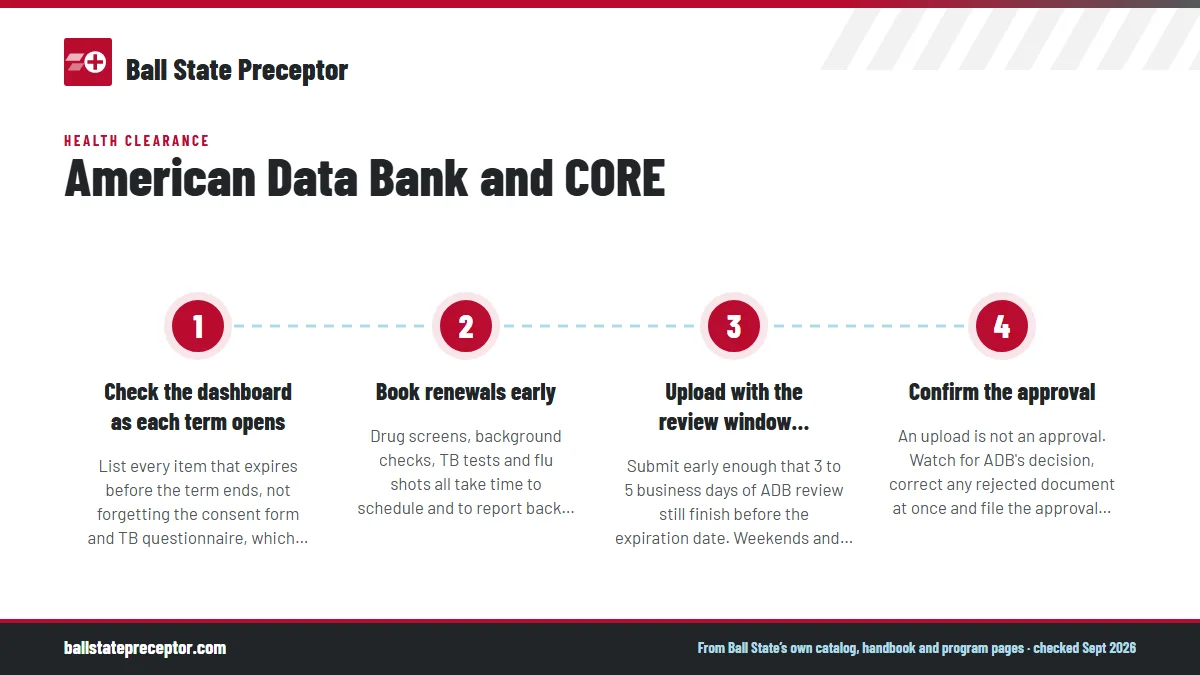
- Check the dashboard as each term opensList every item that expires before the term ends, not forgetting the consent form and TB questionnaire, which recur each term.
- Book renewals earlyDrug screens, background checks, TB tests and flu shots all take time to schedule and to report back. Start weeks ahead of the date, not days.
- Upload with the review window counted inSubmit early enough that 3 to 5 business days of ADB review still finish before the expiration date. Weekends and holidays do not count as business days.
- Confirm the approvalAn upload is not an approval. Watch for ADB's decision, correct any rejected document at once and file the approval email.
What happens when you fall out of compliance
Noncompliance stops the clock on your clinical course. Under the handbook, a graduate student deemed noncompliant cannot accumulate clinical hours, and any hours completed during that stretch have to be done again. In a course like NUR 681, where 120 hours average about one clinical day a week, a single missed renewal can cost a week of precepted time and some of the goodwill of the preceptor who gave it.
The sanctions go further than lost hours. Each clinical course carries Clinical Expectation Points that drop for every noncompliant week, and repeated lapses in one semester lead to an automatic clinical failure, which counts against Ball State's limit of one failed course. Point values, the appeal route and the rest of the sanction rules are on the compliance checklist. If hours are already slipping, behind on clinical hours covers what to do next.
The expiration date in ADB is the approval deadline. Upload on that date and you are already noncompliant, and any clinical hours you log before ADB approves the item will have to be repeated.
Keeping track is your job, by Ball State's rule
Ball State is direct about who watches the dashboard. The handbook makes it the student's responsibility to follow ADB's postings and messages, says it is not the School's job to prompt you, and names you as solely responsible for knowing your clearance status. Reminders may arrive, but the rule does not depend on them.
ADB also stays out of the conversation with your faculty: it does not notify instructors when a problem is fixed. Proof has to come from you: forward ADB's approval message or a dashboard screenshot showing full compliance, and save both each time an item clears. Read your BSU email daily as well. The handbook expects replies within 48 hours on weekdays, and messages sent from personal accounts are deleted unanswered.
Questions about a requirement itself go to the SON Graduate Program and Compliance Coordinator, whose duties include health clearance and compliance. The who does what guide maps every other role that touches a clinical course.
Moves, name changes, renewed licenses and breaks
Your ADB record has to match your life as it is now. Four changes catch students out:
- Moving: update your address in Self-Service Banner within seven days, email the Clinical Placement Coordinator within seven days with both your previous and your new state, and upload the new state's license documentation for ADB to approve. The new state must be one where your program is authorized; see clinicals outside Indiana.
- Changing your name: notify the Registrar, the School of Nursing, American Data Bank and your faculty.
- Renewing your RN license: ADB's license record must show the license number and expiration date, so upload the renewed license as soon as it posts. Indiana's RN renewal cycle ends on October 31 of odd years, so the next Indiana date is October 31, 2027.
- Taking a break: three semesters without completing a nursing course archives your health clearance account, and returning means a petition to the Graduate Admission and Progression (GAP) Committee. An approved leave instead, for no more than two semesters in a row, avoids the petition.
How we keep your clearance moving
Our placement desk treats clearance as part of the placement. When we match you with a preceptor for a Ball State course, we note the clinical start date, list every ADB item that expires before the course ends and send you the renewal dates with the review window already counted in. We also ask the agency up front what it adds to Ball State's list, so its own onboarding is settled before week one.
The preceptor, the affiliation agreement and your clearance all have to be ready on the same first day, so we work a semester or more ahead, as Ball State advises, and keep a backup site in view. You stay in charge of your ADB account; we make sure every date in it lines up with your placement. Tell us your next course on the placement request form.
Questions Ball State students ask
What does CORE stand for at Ball State?
Ball State does not say. The graduate handbook refers only to ADB and CORE accounts, and the bachelor's handbook uses the name CORE-ELMS. What matters is the step: link CORE to ADB when the School tells you to during your first clinical semester, because an unlinked account is treated as noncompliant.
Do weekends count toward American Data Bank's review time?
The handbook gives the review window in business days, so a Friday upload may not be looked at until the next week, and a holiday stretches it further. Plan as if all five business days will be used, and upload before a long weekend rather than after it.
Will my instructor know once my ADB status is fixed?
Not from ADB. The handbook says ADB will not inform instructors directly, so you send your course faculty the ADB approval email or a screenshot of a fully compliant dashboard. Until your faculty have that proof they cannot see the fix, so send it the same day ADB approves the item.
Does American Data Bank replace the clinical packet paperwork?
No. ADB holds your health clearance only. Preceptor forms, evaluations, the time sheet and the agency's affiliation agreement belong to the clinical packet and the placement process, handled with your course faculty and the School's placement and compliance staff. A clinical course needs both sides in order.
What if my clinical site has its own compliance system?
Many hospitals onboard students through their own process, and Ball State's handbook says students must meet any extra requirements a site sets. Keep ADB current for Ball State and the site's system current for the site, and track both sets of dates together.
Related pages
Last checked 2026-09-26
We check these pages against Ball State's own catalog, graduate handbook, program pages and State Authorization Map, and Indiana rules. Your course faculty, your advisor and the Graduate Clinical Placement Coordinator have the final word.
Ball State asks you to find your preceptor. We find one near you.
Tell us your Ball State track, where you live and when your next clinical course starts. We find preceptors near you who fit the course, confirm the practice will sign Ball State's affiliation agreement, and line up a backup, so the School of Nursing can clear the site before the semester.
- Preceptors matched to the course: pediatrics for
NUR 682, women's health forNUR 684, adult primary care forNUR 681andNUR 683 - Outside your own unit or clinic, in a state where Ball State's program is authorized
- Across Indiana, from Muncie to Evansville, and in the other states Ball State accepts
Start your placement plan
Program, city and start date is all we need to begin.