Precepting a Ball State FNP student: the courses, the paperwork and your part
A Ball State family nurse practitioner student has asked you to precept, or a placement advisor has asked for them. Here is what each clinical course asks of a practice, how Ball State's affiliation agreement and clinical packet reach your office, and what the student clears before day one.
Tell us about your practice
Choose "I'm a preceptor" under Program, add your city and state, and a placement advisor will follow up about Ball State students near you.
Why a Ball State student is asking you
Ball State asks its FNP students to line up preceptors in their home communities, and the School of Nursing looks for students to take an active part in every placement, with faculty ready to help if problems arise. So the request reaches you from the student, or from our placement desk working for that student, rather than from the University.
The student is a registered nurse studying online, with an active, unencumbered RN license in the state of practice. Their home and every clinical hour both have to sit in a state Ball State's program is authorized in, so your state matters as much as your specialty.
What each clinical course asks of a practice
Six courses carry the 690 FNP clinical hours, and Ball State wants them in primary care or clinic settings rather than acute care. Family Nurse Practitioner is Ball State's only NP specialty, so each course prepares a family practice clinician.
| Course | Title | Clinical hours | Average pace |
|---|---|---|---|
NUR 634 | Advanced Health Assessment | 60 | About 1 day a week |
NUR 681 | Primary Care of the Adult 1 | 120, of which 8 are on campus in Muncie | About 1 day a week |
NUR 682 | Primary Care of Children | 120 | About 1 day a week |
NUR 683 | Primary Care of the Adult 2 | 120 | About 1 day a week |
NUR 684 | Primary Care of Women | 90 | Not published |
NUR 673 | Practicum-Family Nurse Practitioner | 180 | About 1.5 to 2 days a week |
Pediatric patients are the core of NUR 682, a women's health caseload of NUR 684, and adult primary care of NUR 681 and NUR 683. NUR 673 comes after every other concentration course. Hour totals and course order are on the 690-hour guide.
The affiliation agreement comes first
Before the student logs an hour with you, Ball State University and your organization, the clinical agency, need a signed affiliation agreement. It is a contract between institutions, not a form for you personally.
Ball State strongly encourages agencies to sign its standard affiliation agreement, and it warns that negotiating an agency's own contract can make approval take considerably longer. The School of Nursing accepts only the original signed document, never a fax, scan, photocopy or photo of it. Ball State suggests tentative arrangements begin about a semester before the course, which is why students may approach you well ahead of the term. The affiliation agreements guide has the rest.
Qualifications, onboarding and the forms you will see
Ball State keeps its FNP preceptor criteria in the Nurse Practitioner clinical packet, inside the Nursing Grad Students Canvas Community that enrolled students open. Its section on preceptor qualification and responsibilities settles, with the student's course faculty, whether a physician, DO or physician assistant fits a given course, so ask the student to confirm before you commit. The public side is on the preceptor requirements guide.
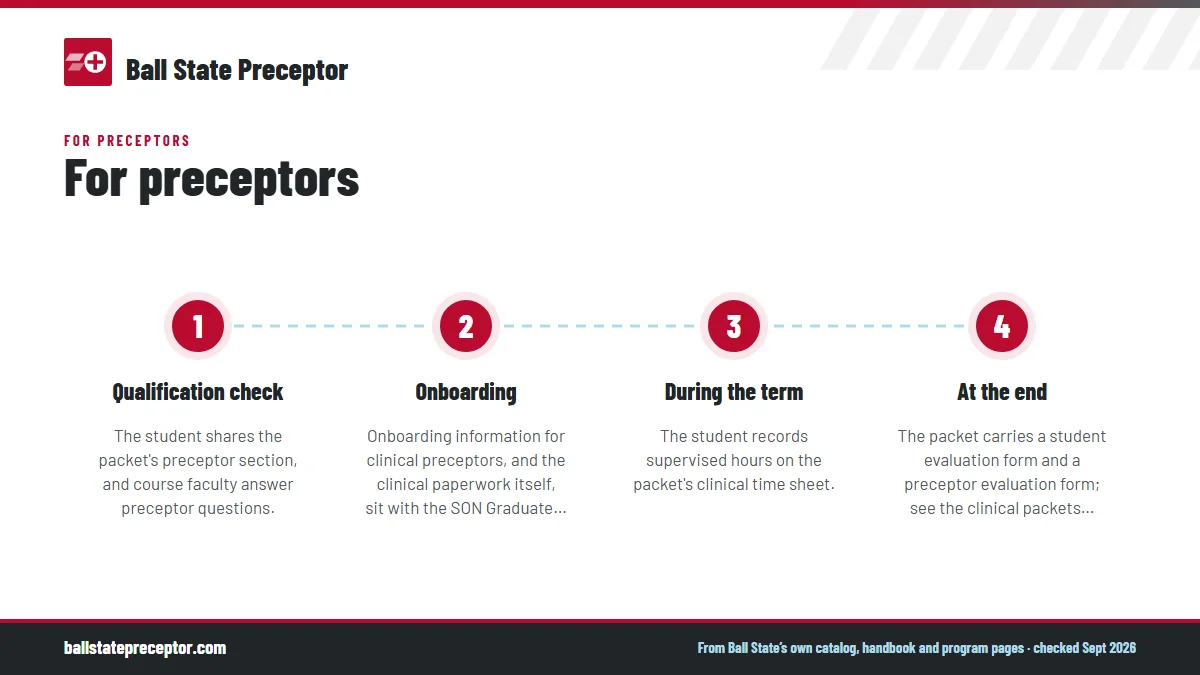
- Qualification checkThe student shares the packet's preceptor section, and course faculty answer preceptor questions.
- OnboardingOnboarding information for clinical preceptors, and the clinical paperwork itself, sit with the SON Graduate Program and Compliance Coordinator.
- During the termThe student records supervised hours on the packet's clinical time sheet.
- At the endThe packet carries a student evaluation form and a preceptor evaluation form; see the clinical packets guide.
How your evaluation counts
Your judgment carries weight. Under Ball State's graduate handbook, course faculty and preceptors both judge a student's clinical work, the verdict is satisfactory or unsatisfactory, and unsatisfactory clinical performance earns an F for the course. A second failed course means dismissal from the program, so specific feedback during the term, while there is time to improve, matters.
Course faculty stay responsible for the course and are your contact for concerns about requirements or hours. In certain states Ball State adds a clinical supervisor, a second person on site who also evaluates the student, so you may be asked to suggest a colleague.
The student arrives cleared
Health clearance runs through American Data Bank (ADB), linked to a CORE account in the student's first clinical semester. The list covers immunizations, TB testing, an influenza form, OSHA and HIPAA training, a background check, a 10-panel drug screen, personal health insurance, a two-year American Heart Association BLS or ACLS card and RN license documentation, with several items renewed yearly.
A student Ball State deems noncompliant cannot accumulate clinical hours. Your organization may add requirements of its own, which students must meet, and any clinical site may still decline a student. Deadlines and sanctions sit on the American Data Bank page.
Indiana practice and health system rules
An Indiana nurse practitioner who prescribes does so under a written practice agreement with a collaborating licensed practitioner (848 IAC 5-1-1), and the 2026 bills to drop that requirement stalled in committee, so your collaboration shapes what a student sees. See the Indiana NP practice guide.
Large systems set student rules too. According to its student page, IU Health limits placements to students who live in Indiana and hold an Indiana nursing license, runs advanced practice matching through its Office of Clinical Education, and tells students to stay away from direct approaches to its providers. Inside a system like that, the request travels through its student office.
How our placement desk works with your practice
When a placement advisor brings you a Ball State student, the course, hours, pace and dates are already set out, and the student's state, workplace and clearance have been checked against Ball State's rules. We confirm with your office who signs the agreement and how the original travels, pass the School of Nursing what onboarding needs, keep a backup site ready for the student and stay reachable through the term.
Practices open to hosting Ball State students can tell us which courses fit their caseload and which days and terms are open. Choose "I'm a preceptor" on the request form.
Questions Ball State students ask
Who at my practice signs Ball State's affiliation agreement?
Whoever can sign contracts for the practice or health system, such as an administrator or a legal office, since the agreement binds the organization rather than an individual clinician. Ball State accepts only the original signed document, so find out early where the signer sits and how the original will be sent to the School of Nursing.
Can I precept a Ball State student who works in my health system?
Possibly. Ball State's FAQ says clinicals cannot happen in the student's own unit or clinic, so a student employed by your system would need to train in a different unit or clinic from the one where they work. Confirm the arrangement with the student's course faculty before the term starts.
Can one practice host a student for more than one course?
Yes, if the caseload fits. Ball State's FNP page puts 682 of the 690 hours within reach of a family practice primary care setting, so a practice seeing adults, children and women can suit several courses. Whether the agreement already on file carries over to later terms is a question for the Graduate Clinical Placement Coordinator.
What if the student cannot finish the hours during the term?
Tell the student and their course faculty early. Incomplete grades are granted only for extenuating circumstances under a written agreement, and an Incomplete in NUR 634 or NUR 681 to NUR 684 blocks the next NP clinical course until the work is done. Hours worked while the student is out of compliance do not count and must be repeated.
Related pages
Last checked 2026-09-26
We check these pages against Ball State's own catalog, graduate handbook, program pages and State Authorization Map, and Indiana rules. Your course faculty, your advisor and the Graduate Clinical Placement Coordinator have the final word.
Ball State asks you to find your preceptor. We find one near you.
Tell us your Ball State track, where you live and when your next clinical course starts. We find preceptors near you who fit the course, confirm the practice will sign Ball State's affiliation agreement, and line up a backup, so the School of Nursing can clear the site before the semester.
- Preceptors matched to the course: pediatrics for
NUR 682, women's health forNUR 684, adult primary care forNUR 681andNUR 683 - Outside your own unit or clinic, in a state where Ball State's program is authorized
- Across Indiana, from Muncie to Evansville, and in the other states Ball State accepts
Start your placement plan
Program, city and start date is all we need to begin.