The 690 FNP clinical hours at Ball State, course by course
Ball State's online FNP concentration spreads 690 supervised clinical hours across six courses, opening with 60 in NUR 634 and closing with 180 in NUR 673. Most of them average one clinical day a week, the final practicum nearer two, and NUR 610 adds 45 hours that Ball State keeps outside the 690.
Get your placement plan
Tell us your Ball State program and where you live. A placement advisor replies with preceptor and site options in your community that fit your Ball State course.
NUR 681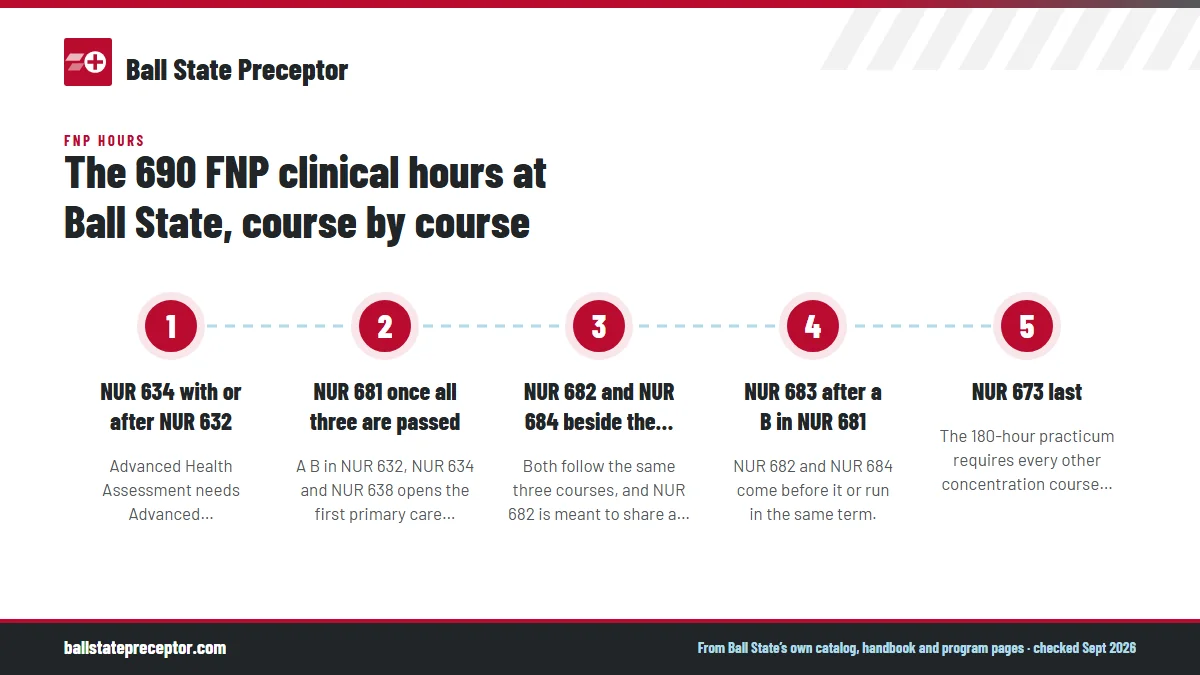
Six courses, 690 hours
Hours are taken from the FNP and certificate program pages; the sequence follows the 2026-27 catalog's prerequisites. The certificate page supplies the average clinical days and lists NUR 684 by hours alone.
| Course | Credits | Clinical hours | Average clinical time | Comes after |
|---|---|---|---|---|
NUR 634 Advanced Health Assessment | 3 | 60 | About 1 day a week | NUR 632, first or in the same term |
NUR 681 Primary Care of the Adult 1 | 4 | 120, with 8 on campus in Muncie | About 1 day a week | A B in NUR 632, NUR 634 and NUR 638 |
NUR 682 Primary Care of Children | 4 | 120 | About 1 day a week | NUR 632, NUR 634, NUR 638; alongside NUR 681, NUR 683 or NUR 684 |
NUR 683 Primary Care of the Adult 2 | 4 | 120 | About 1 day a week | A B in NUR 681; NUR 682 and NUR 684 before or with it |
NUR 684 Primary Care of Women | 4 | 90 | Not stated | NUR 632, NUR 634, NUR 638 |
NUR 673 Practicum-Family Nurse Practitioner | 5 | 180 | About 1.5 to 2 days a week | Every other course in the concentration |
| Total | 690 |
Each course has its own guide: NUR 634 health assessment, NUR 681 adults, part 1, NUR 682 children, NUR 683 adults, part 2, NUR 684 women and NUR 673 the final practicum.
690 or 735: which total is yours
Ball State describes the FNP as 48 credits and 690 supervised clinical hours. Its course list on the same page, though, includes NUR 610 with 45 clinical hours, and adding every listed course gives 735. The reason sits in Ball State's 2018 master's information packet, which said the NUR 610 hours do not count toward the FNP clinical total.
In practice you complete both sets: the 690 in the six FNP courses and the 45 in NUR 610, a shared MS core course whose clinical experiences, per the catalog, focus on population health promotion. Ball State publishes no setting for those 45 hours beyond that focus, so ask your course faculty what fits, and plan for 735 supervised hours across the degree when you map out your year.
The 682 hours and the family practice route
Ball State's FNP page lets 682 of the 690 hours take place in family practice primary care. The 8 left over match the one clinical day Ball State requires on its Muncie campus during NUR 681. The MS FAQ adds two limits for every FNP course: primary care or clinic work rather than acute care, and a site other than your own unit or clinic.
For planning, that opens a useful door. A family practice with a broad panel of adults, children and women could, with faculty approval, host several of your courses, which means fewer new agencies to bring on board. Each course is still approved on its own, with its own packet and evaluations, and a family practice that sees few children or little women's health may not fill NUR 682 or NUR 684. Your course faculty decide whether a site fits.
Days per week and the weekly load
Ball State's certificate page sets the pace course by course: roughly a clinical day a week for NUR 634 and the first three primary care courses, and 1.5 to 2 days weekly for NUR 673. The MS in Nursing page estimates a clinical course at 8-12 hours weekly and online coursework at 6-10, and the graduate handbook plans on two classes per semester.
When two clinical courses share a term, such as NUR 681 with NUR 682, Ball State's averages add up to about two clinical days a week plus coursework. Fall and spring semesters run 15 weeks from Fall 2026 and summer runs 10, and Ball State does not publish whether graduate NUR courses fill all 15 weeks or a 7-week block. Our own arithmetic: 180 hours over 15 weeks is 12 hours a week, in line with the 1.5 days Ball State gives for NUR 673.
The order the catalog sets
Ball State emails each FNP student an individual plan of study after admission and posts no sample plan, so there is no public term-by-term calendar. The catalog's prerequisites still fix the sequence of the clinical courses:
NUR 634with or afterNUR 632Advanced Health Assessment needs Advanced Pathophysiology first or in the same term, andNUR 638Advanced Clinical Pharmacology is tied toNUR 632the same way.NUR 681once all three are passedA B inNUR 632,NUR 634andNUR 638opens the first primary care course, which holds the Muncie campus day.NUR 682andNUR 684beside the adult coursesBoth follow the same three courses, andNUR 682is meant to share a term with one of the adult or women's courses.NUR 683after a B inNUR 681NUR 682andNUR 684come before it or run in the same term.NUR 673lastThe 180-hour practicum requires every other concentration course, and FNP students take a board review course inside it.
That chain means at least four consecutive terms with a clinical course, each needing a preceptor. The handbook warns that not every course runs every semester and that leaving your plan can cost two or three semesters, and an Incomplete in NUR 634 or NUR 681 to NUR 684 holds back the next NP clinical course until it is cleared.
Lining up preceptors for all six courses
Ball State's graduate handbook wants clinical planning under way twelve months before each course. Its Current Student Resources page then wants the agency approached about one term out, on Ball State's own agreement form, with a second agency in reserve each semester. Across four or more clinical terms that becomes a rolling search: while one course runs, the next two need sites.
We run that search for you. For each FNP course we find a preceptor near you whose practice fits it, confirm the site sits outside your own unit and inside an authorized state, open the agreement early and keep a spare site ready. Several Indiana health systems flag pediatric and women's health preceptors as scarce, so we start on NUR 682 and NUR 684 first. Ball State's faculty approve every site. Send us your plan of study dates.
Questions Ball State students ask
Can I finish Ball State's FNP in six semesters?
Ball State's FNP page describes the program as six or eight semesters and 48 credits. The catalog's prerequisites need at least four consecutive terms with a clinical course, and your emailed plan of study sets the exact sequence. Staying on that plan matters, since the handbook warns that stepping off it can push some courses back two or three semesters.
Does acute care count toward the 690 FNP hours?
Ball State's MS FAQ places FNP clinicals in a primary care or clinic setting rather than acute care, and the FNP page says 682 of the hours can be in family practice primary care. A hospital unit falls outside that description. If a clinic belongs to a hospital, ask your course faculty whether it qualifies before you count on it.
Do certificate students complete the same 690 hours?
Only some of them. The Post-Master's Certificate FNP runs from 390 to 690 hours. Students whose master's is in a non-NP specialty take the full primary care sequence, while adult and adult-gerontology NPs take NUR 682, NUR 684 and NUR 673. A transcript review decides whether NUR 634 and its 60 hours are added.
When can I sit for FNP certification after my hours?
Ball State's graduate handbook lets FNP students sit for the ANCC or AANP certification exam in their final semester or after finishing. The Graduate Programs Director handles NP certification exam applications and verification of education. The board review course required in NUR 673 is paid directly to the company that provides it.
Can one preceptor cover more than one FNP course?
Ball State's public documents do not rule it out, and the 682 family practice hours suggest one practice can host much of the concentration. Each course is approved on its own, though, with its own packet and evaluation, so ask your course faculty before you plan two courses with the same preceptor.
Related pages
Last checked 2026-09-26
We check these pages against Ball State's own catalog, graduate handbook, program pages and State Authorization Map, and Indiana rules. Your course faculty, your advisor and the Graduate Clinical Placement Coordinator have the final word.
Ball State asks you to find your preceptor. We find one near you.
Tell us your Ball State track, where you live and when your next clinical course starts. We find preceptors near you who fit the course, confirm the practice will sign Ball State's affiliation agreement, and line up a backup, so the School of Nursing can clear the site before the semester.
- Preceptors matched to the course: pediatrics for
NUR 682, women's health forNUR 684, adult primary care forNUR 681andNUR 683 - Outside your own unit or clinic, in a state where Ball State's program is authorized
- Across Indiana, from Muncie to Evansville, and in the other states Ball State accepts
Start your placement plan
Program, city and start date is all we need to begin.