NUR 673 Practicum-Family Nurse Practitioner: the last 180 hours
NUR 673 Practicum-Family Nurse Practitioner closes Ball State's FNP sequence with 5 credits, 180 supervised clinical hours and an average of 1.5 to 2 clinical days a week, taken only after every other concentration course. It also carries a required board review course and ends with the practicum documentation Ball State needs before you can graduate.
Setting up your NUR 673 practicum?
Tell us your final term and home area. Your placement advisor looks for a family practice preceptor who can host you 1.5 to 2 days a week.
NUR 673, the largest block in the FNP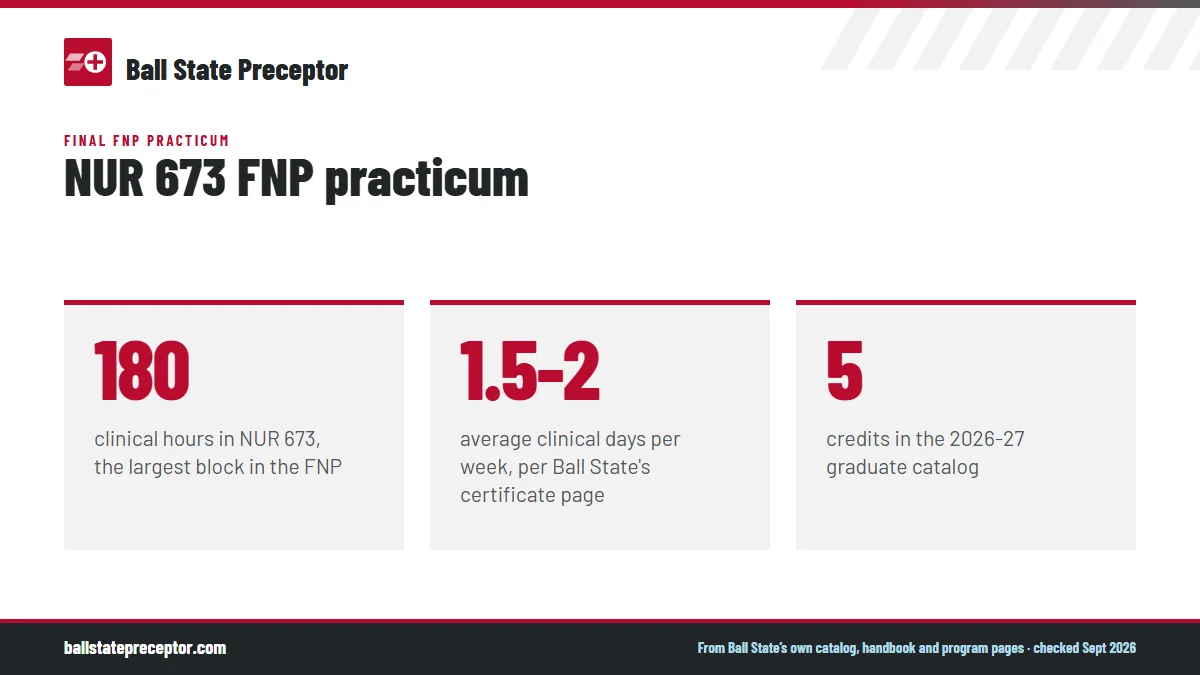
Where NUR 673 sits in your plan
The 2026-27 catalog makes every other course in the family nurse practitioner concentration a prerequisite for NUR 673, so it is always your final clinical term. By the time you enroll, health assessment and the four primary care courses have given you 510 of the FNP's 690 hours (our arithmetic), and the practicum supplies the remaining 180.
| Item | What Ball State says | Source |
|---|---|---|
| Credits | 5 | 2026-27 graduate catalog |
| Clinical hours | 180 | FNP page and post-master's certificate page |
| Average clinical time | 1.5 to 2 days per week | Post-master's certificate page |
| Prerequisite | All other courses in the FNP concentration | 2026-27 graduate catalog |
| Built-in requirement | A board review course; the student pays the review company directly | Graduate Nursing Handbook 2025-26 |
| Who takes it | MS in Nursing FNP and both post-master's FNP certificate tracks | FNP and certificate pages |
The syllabus, the clinical expectations and the evaluation forms live in the NP clinical packet on Canvas. Our 690-hour breakdown shows how each earlier course contributes.
Scheduling 1.5 to 2 days a week
The practicum asks for more clinic time each week than the courses before it, which Ball State averages at about one day. Our arithmetic, not a Ball State figure: 180 hours over a 15-week fall or spring term is 12 hours a week, and inside the 10-week summer term it is 18. In 2026-27, fall runs August 24 to December 11, spring January 11 to April 30 and summer May 17 to July 23. Whether the practicum runs all 15 weeks or a shorter session is not on Ball State's public pages, so confirm your dates before you give a preceptor a schedule.
For a working RN, two clinic days a week usually means reshaping your shifts for a whole term. Settle that with your employer while you settle the preceptor, and ask the practice for a fixed weekly pattern rather than whichever days happen to open up. A predictable schedule also makes the time sheet in your clinical packet far easier to keep.
The right preceptor for the final practicum
Ball State's FNP page counts nearly the whole program, 682 hours, as suitable for family practice, and the MS FAQ keeps all FNP clinical time out of acute care and off your own unit or clinic. For NUR 673, a family practice that treats patients across the lifespan is the most direct fit, since this is the last supervised stretch before you sit for FNP certification. Your course faculty confirm the site against the syllabus.
Capacity matters as much as specialty. The preceptor needs a schedule full enough to host you 1.5 to 2 days every week for the entire term, with the patient volume to make those days count. Ball State sets preceptor qualifications in the Canvas clinical packet rather than on its public pages; our preceptor requirements page summarizes what is known.
The practicum has no later term to absorb a gap. A preceptor who withdraws halfway through can push back graduation, so line up a backup agency before the term starts, as Ball State advises for every semester.
The board review inside NUR 673
The Graduate Nursing Handbook 2025-26 makes a board review course a required part of the NUR 673 practicum, and students pay its fees directly to the company that runs it. Ball State also charges a clinical course fee on each graduate clinical course, so budget for both in your final term.
According to the handbook, FNP students may sit for the family nurse practitioner certification exam from the AANP or the ANCC either in their last semester or after completing the program. The Graduate Programs Director handles Ball State's side of the certification exam application and the verification of education. Ball State has not posted a current FNP certification pass rate. Our certification exam guide goes further.
Finishing: final documentation and graduation
Ball State's handbook ties graduation to the submission of all final practicum documentation, and it lists the Exit and Graduate Surveys among the closing steps. Among the NP packet's contents are a time sheet for clinical hours and evaluation forms for both you and your preceptor, so treat every signature the packet asks for as part of that documentation and collect them before your last clinical day.
Graduation is not automatic. The Graduate School's 2026-27 application deadlines are October 21, 2026 for fall, March 10, 2027 for spring and June 9, 2027 for summer, filed in Self-Service Banner through MyBallState, and late applications are refused. Nursing pinning ceremonies follow in May, July and December. The 2026-27 calendar guide has the rest of the dates.
How we set up your final practicum
Because the practicum carries the heaviest weekly load and the least room for delay, we treat it as the placement to secure earliest. We look for a family practice preceptor near home, in your authorized state, whose schedule can take you 1.5 to 2 days every week, and we confirm that pattern with the practice before you commit. Each candidate is checked against Ball State's rules, and a backup is held for the same term.
You get what the clinical packet and the standard affiliation agreement need, plus a checklist for keeping American Data Bank and CORE current through your final term. Ball State's faculty and placement staff review and approve the site. If a preceptor leaves late in the term, your placement advisor activates the backup so your graduation date holds. Start with the request form.
Questions Ball State students ask
Can I complete NUR 673 hours at the practice where I work?
Not in your own unit or clinic: Ball State's MS FAQ rules that out for FNP clinicals. Whether a sister practice under your employer qualifies is for your course faculty to decide, since Ball State has not published a rule. Our workplace clinicals guide explains how students handle it.
Do post-master's certificate students take NUR 673?
Yes. Both tracks of Ball State's post-master's FNP certificate end with NUR 673 and its 180 hours, whether you came from a non-NP master's or from an Adult or Adult-Gerontology NP program. The certificate is open only to residents of the states it is authorized in, and Ball State's own sources list those states differently, so check before you commit a preceptor.
What is the DNP's counterpart to NUR 673?
In the DNP's FNP cognate, the closing clinical course is NUR 785 Primary Care Immersion, taken after NUR 783 and NUR 784. Post-master's DNP students complete 475 practicum hours in it. A transition-to-practice course, NUR 786, comes after it with no clinical hours listed. The DNP clinical hours guide covers the rest.
Can I take NUR 673 in the same term as another clinical course?
The 2026-27 catalog lists every other FNP concentration course as a prerequisite, so the practicum cannot share a term with any primary care course. A lingering Incomplete in one of those courses blocks the practicum as well until that course is passed, which can move your final term back.
Is the board review course the same as the certification exam?
No. The review is a preparation course Ball State builds into the practicum, and you pay the review company for it yourself. The certification exam is a separate step taken with the AANP or the ANCC, and you apply to that board yourself, with the Graduate Programs Director handling Ball State's part of the paperwork.
Related pages
Last checked 2026-09-26
We check these pages against Ball State's own catalog, graduate handbook, program pages and State Authorization Map, and Indiana rules. Your course faculty, your advisor and the Graduate Clinical Placement Coordinator have the final word.
- Ball State Online: MS in Nursing, Family Nurse Practitioner
- Ball State 2026-27 Graduate Catalog: NUR 673
- Ball State Online: Post-Master's Certificate in Nursing (FNP)
- Ball State School of Nursing: Current Student Resources (Graduate Student Handbook)
- Ball State Graduate School: Current Graduate Students (graduation deadlines)
Ball State asks you to find your preceptor. We find one near you.
Tell us your Ball State track, where you live and when your next clinical course starts. We find preceptors near you who fit the course, confirm the practice will sign Ball State's affiliation agreement, and line up a backup, so the School of Nursing can clear the site before the semester.
- Preceptors matched to the course: pediatrics for
NUR 682, women's health forNUR 684, adult primary care forNUR 681andNUR 683 - Outside your own unit or clinic, in a state where Ball State's program is authorized
- Across Indiana, from Muncie to Evansville, and in the other states Ball State accepts
Start your placement plan
Program, city and start date is all we need to begin.