Who can precept a Ball State nursing student
Ball State publishes one preceptor credential in plain words: the 180-hour NUR 672 role practicum runs under a master's- or doctoral-prepared RN. For the FNP courses, the qualifications sit in the clinical packet that admitted students open in Canvas, so the answer to who may precept NUR 634 through NUR 673 comes from that packet and your course faculty, not from any public page.
Get your placement plan
Tell us your Ball State program and where you live. A placement advisor replies with preceptor and site options in your community that fit your Ball State course.
The one credential Ball State prints
Educator and leadership students get a clear public answer. The Nurse Educator and Leadership and Management concentration pages both say the 180 practicum hours in NUR 672 Practicum of Role Expectations are completed under a master's- or doctoral-prepared RN in your community, and both allow that practicum at your workplace. The 2026-27 catalog pictures the course in either an education or an administration setting.
The focus changes with the concentration. Ball State calls the leadership practicum leadership-focused rather than bedside care, and the educator practicum education-focused. In practice that points a leadership student toward a nurse manager, director or executive with a graduate degree, and an educator student toward a nurse educator or professional development lead with one. Whoever it is, the wording asks for two things together: an RN license and a master's or doctoral degree.
The post-master's Nurse Educator certificate uses the same NUR 672 course, though its catalog entry says nothing about placement. Expect the same RN rule and confirm it in the Educator clinical packet. The role practicum guide covers the hours and the project.
FNP preceptors: the criteria sit in the clinical packet
Ball State does not publish FNP preceptor credentials. The Graduate Nursing Handbook 2025-26 gives the NP, Educator and Administrator concentrations each a clinical packet, kept inside the Nursing Grad Students Canvas Community, and one section of each is titled "Preceptor qualification and responsibilities." The MS FAQ adds that course requirements reach admitted students after orientation.
So the public web cannot tell you whether a physician, a DO or a physician assistant may precept a given FNP course, or how much practice experience a nurse practitioner preceptor needs. Any page that states Ball State's answer without the packet is guessing. Read the packet for your concentration and take preceptor questions to your course faculty, the role the handbook gives them.
The public pages do fix the setting. Ball State's FAQ puts FNP clinicals in primary care or clinics, away from acute care and away from your own unit or clinic, and the FNP page says all but 8 of the 690 hours can happen in a family practice primary care setting. Each course narrows the search again: NUR 682 needs pediatric patients and NUR 684 women's health, while NUR 681 and NUR 683 center on adults. The clinical packets guide lists what else the packet holds.
The clinical supervisor some states add
Some students need a second person on site. The handbook says graduate students are evaluated by course faculty and preceptors, and that students residing in certain states may also be evaluated by a clinical supervisor. It does not name those states, so ask the Graduate Clinical Placement Coordinator whether yours is one before you settle on a site.
The handbook's warning about late planning lists three things a student can fail to secure: a clinical site, a clinical supervisor and a preceptor. Ball State's archived 2018 information packet described the clinical supervisor as a second person the student chooses to evaluate them on site in advanced role courses. Treat that packet as history rather than current policy, but it confirms the supervisor is a separate person from the preceptor.
Where your state calls for one, look for the supervisor inside the same agency as the preceptor. That keeps the affiliation agreement to a single organization and gives both people the same view of your work.
DNP roles: project preceptor mentor and content expert mentor
Ball State's DNP builds its clinical work around mentors. The handbook's Project Preceptor Mentor sits on the DNP Project Committee, orients the student to the agency's policies and protocols, and writes an evaluation of the student that is reviewed with the student and sent to the project faculty advisor. A Content Expert Mentor serves as an external member of the same committee.
Faculty share the load. The faculty advisor orients both mentors with written materials and phones the Project Preceptor Mentor for an interview as NUR 793 and NUR 794, the second and third DNP Project courses, come to a close. Implementation waits until the IRB has approved the project, clearance is complete, both an agency agreement and a practicum mentor agreement are signed, and the advisor gives final approval.
In the executive and educator cognates, the NUR 787 catalog entry has faculty and a preceptor guiding the student together, and NUR 788 practicum experiences are shaped for each student in coordination with faculty. The DNP hours guide covers the project site and the conflicting hour totals.
How a preceptor is brought on board
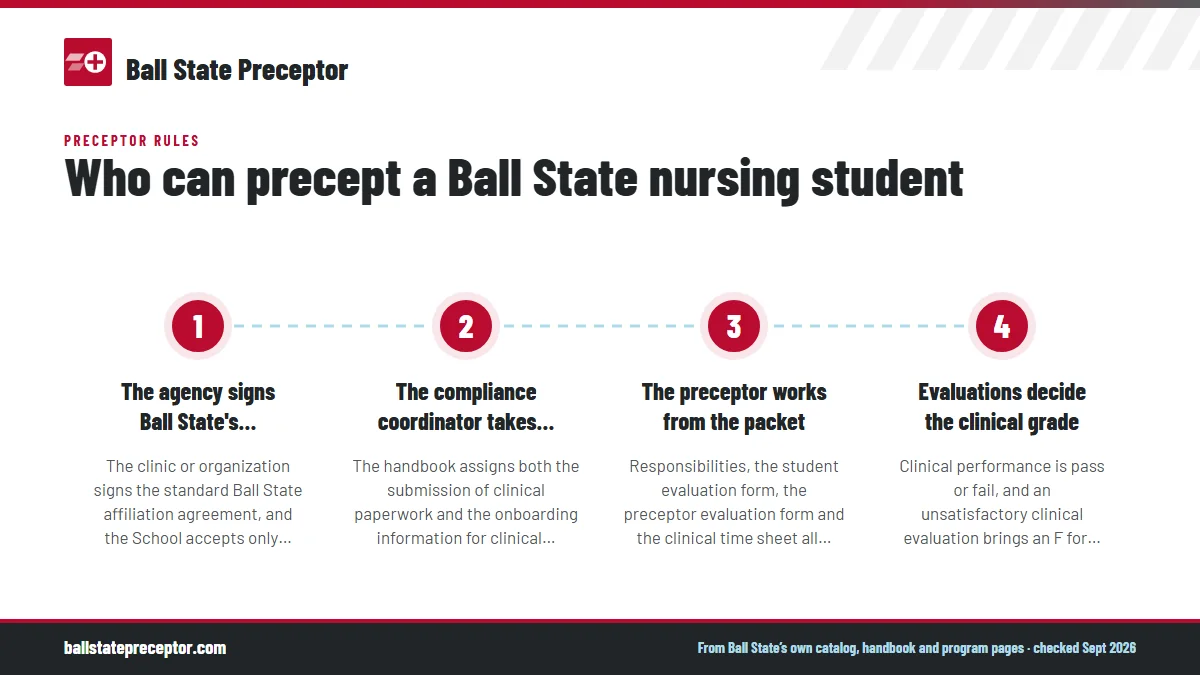
Onboarding runs through the School of Nursing, not through the student alone. Here is the sequence the public documents support.
- The agency signs Ball State's agreementThe clinic or organization signs the standard Ball State affiliation agreement, and the School accepts only original signed copies. The affiliation agreements guide explains the timing.
- The compliance coordinator takes the paperworkThe handbook assigns both the submission of clinical paperwork and the onboarding information for clinical preceptors to the SON Graduate Program and Compliance Coordinator.
- The preceptor works from the packetResponsibilities, the student evaluation form, the preceptor evaluation form and the clinical time sheet all come from the clinical packet for your concentration.
- Evaluations decide the clinical gradeClinical performance is pass or fail, and an unsatisfactory clinical evaluation brings an F for the course. Graduation also depends on submitting all final practicum documentation.
Indiana practice context for NP preceptors
Indiana nurse practitioners practice in collaboration with a licensed practitioner under a practice agreement, or through hospital privileges. Prescriptive authority under 848 IAC 5-1-1 depends on a written practice agreement, and the 2026 bills to remove that requirement stalled in committee. An Indiana NP preceptor therefore works inside a collaborative arrangement you may see in clinic; the Indiana NP practice guide explains it.
Indiana law does not tell graduate programs who must find NP preceptors or which credentials those preceptors need. The state's preceptor statute and the Board's rule asking for three years of RN experience are written for pre-licensure programs, the practical, associate, diploma and baccalaureate kind. For Ball State's NP courses, the clinical packet sets the bar.
Health systems add their own conditions on top. IU Health, for one, accepts only students who both live in Indiana and hold an Indiana nursing license, according to its student page, and its student manual forbids contacting its providers directly.
What we confirm before a preceptor reaches Ball State
Your placement advisor starts from the exact course you are about to take. We match the preceptor's specialty to that course, work from the packet criteria you share with us, confirm the practice sits outside your own unit or clinic and inside a state authorized for your program, and ask the agency early whether it will sign the standard Ball State agreement.
Then we assemble what the School needs from the site: the agency contact for the agreement, the preceptor's details for onboarding, and a backup site for the same semester. Your course faculty still approve every site, and we see that what lands in front of them fits on the first pass. Begin at the request form, or see how it works first.
Questions Ball State students ask
Can a physician or physician assistant precept a Ball State FNP student?
Ball State's public pages do not say. The answer is in the "Preceptor qualification and responsibilities" section of your clinical packet, which enrolled students open through Canvas. Check it for the course you are entering, and ask your course faculty before a physician, DO or PA commits to you, since a mismatch found late can cost you the semester.
Does a Ball State NUR 672 preceptor have to be a nurse?
Yes. Ball State's Nurse Educator and Leadership and Management pages call for a master's- or doctoral-prepared RN in your community. A health care executive with a graduate degree but no RN license would not match that wording. If your candidate's graduate degree is outside nursing, confirm it with your course faculty before you build the project around them.
Do I need a clinical supervisor as well as a preceptor at Ball State?
Only in some states. The Graduate Nursing Handbook says students residing in certain states may also be evaluated by a clinical supervisor, but it does not list them. Ask the Graduate Clinical Placement Coordinator early, because finding a second qualified person at the same agency adds time to the search.
Who sends my preceptor Ball State's onboarding information?
The handbook gives onboarding information for clinical preceptors to the SON Graduate Program and Compliance Coordinator, who also handles clinical paperwork. The preceptor's responsibilities and evaluation forms come from the clinical packet for your concentration, so share those pages with your preceptor well before your first clinical day.
Can my own manager precept my NUR 672 practicum?
Ball State's public pages do not address it. They let the practicum happen on the job with an RN who holds a master's or doctorate, yet the MS FAQ also rules out clinicals in your own unit. Picking a preceptor from another department or from system leadership sidesteps the issue; if your manager is the natural choice, put the question to your course faculty first.
Related pages
Last checked 2026-09-26
We check these pages against Ball State's own catalog, graduate handbook, program pages and State Authorization Map, and Indiana rules. Your course faculty, your advisor and the Graduate Clinical Placement Coordinator have the final word.
Ball State asks you to find your preceptor. We find one near you.
Tell us your Ball State track, where you live and when your next clinical course starts. We find preceptors near you who fit the course, confirm the practice will sign Ball State's affiliation agreement, and line up a backup, so the School of Nursing can clear the site before the semester.
- Preceptors matched to the course: pediatrics for
NUR 682, women's health forNUR 684, adult primary care forNUR 681andNUR 683 - Outside your own unit or clinic, in a state where Ball State's program is authorized
- Across Indiana, from Muncie to Evansville, and in the other states Ball State accepts
Start your placement plan
Program, city and start date is all we need to begin.