Ball State clinical packets: what they hold and where to find them
Ball State keeps the working rules of each graduate clinical course in clinical packets inside Ball State's Nursing Grad Students Canvas Community. The Graduate Nursing Handbook lists what the packets contain and treats them as part of the handbook, but the packets themselves open only to enrolled students after orientation. This guide separates what is public from what is not and shows how the packet shapes your clinical semester.
Get your placement plan
Tell us your Ball State program and where you live. A placement advisor replies with preceptor and site options in your community that fit your Ball State course.
Where the packets live
Ball State enrolls every graduate nursing student in a Canvas Community called Nursing Grad Students. Per the handbook, it holds clinical information, health forms and a copy of the handbook, and School announcements on registration, clinicals, program changes and graduation deadlines appear there. Course registration numbers arrive by email or through its announcements, and the leave of absence form is kept there as well. Your courses themselves also run in Canvas, so the Community sits alongside your course sites.
According to the handbook, the Community also holds the clinical packets, one set each for Nurse Practitioner students, Educator students and Administrator students. Administrator is the older name for the concentration the 2026-27 catalog calls Nurse Leadership and Management; the handbook on Ball State's site is still the 2025-26 edition, which predates the renaming.
What the handbook says is inside
The Graduate Nursing Handbook lists the packet contents item by item. That list is the entire public description of the packets:
- Clinical paperwork submission policies and deadlines
- Clinical policies
- Clinical information
- Clinical forms
- Preceptor qualification and responsibilities
- Student responsibilities
- Student evaluation form
- Preceptor evaluation form
- Clinical time sheet
Much of what students search for, including FNP preceptor credentials, specific form names and paperwork due dates, falls under those headings and can be read only inside Canvas. Treat any outside description of those details as unconfirmed until you have your own packet in front of you.
The list also shows what sits outside the packet: the agency's contract runs through a separate affiliation agreement, and your health clearance runs through American Data Bank.
Packets carry the weight of the handbook
The handbook states that all information in the packets is considered part of the Graduate Nursing Handbook, so a packet policy or deadline binds you exactly as a handbook rule does. It also makes reading and knowing the packets for your own concentration the student's responsibility.
That links to the progression rules, under which clinical forms, including agency contracts and each required evaluation, must be submitted the way policy directs. Graduation, in turn, needs all final practicum documentation submitted. The contract side of that paperwork is explained in affiliation agreements.
Because the packets count as part of the handbook, a missed packet deadline is a handbook matter, not a small administrative slip. Read your concentration's packet the week it opens.
When you can open yours
The MS in Nursing FAQ says clinical requirements are made available to admitted students after orientation in the program. The handbook requires every student to attend a virtual School of Nursing Graduate orientation, while Ball State's admissions pages describe it differently: the MS and DNP pages mention a one-day session on campus or on Zoom, and the FNP certificate's page mentions a one-day orientation on campus.
Either way, prospective students cannot read a packet before enrolling. For a clinical course that falls early in your plan of study, the handbook's year-ahead planning window may open before your packet does, so begin with the public rules and fit the packet's specifics in the moment you can see them.
Public rules versus packet rules
Some clinical questions have public answers; others wait for the packet. This split shows where to look for each.
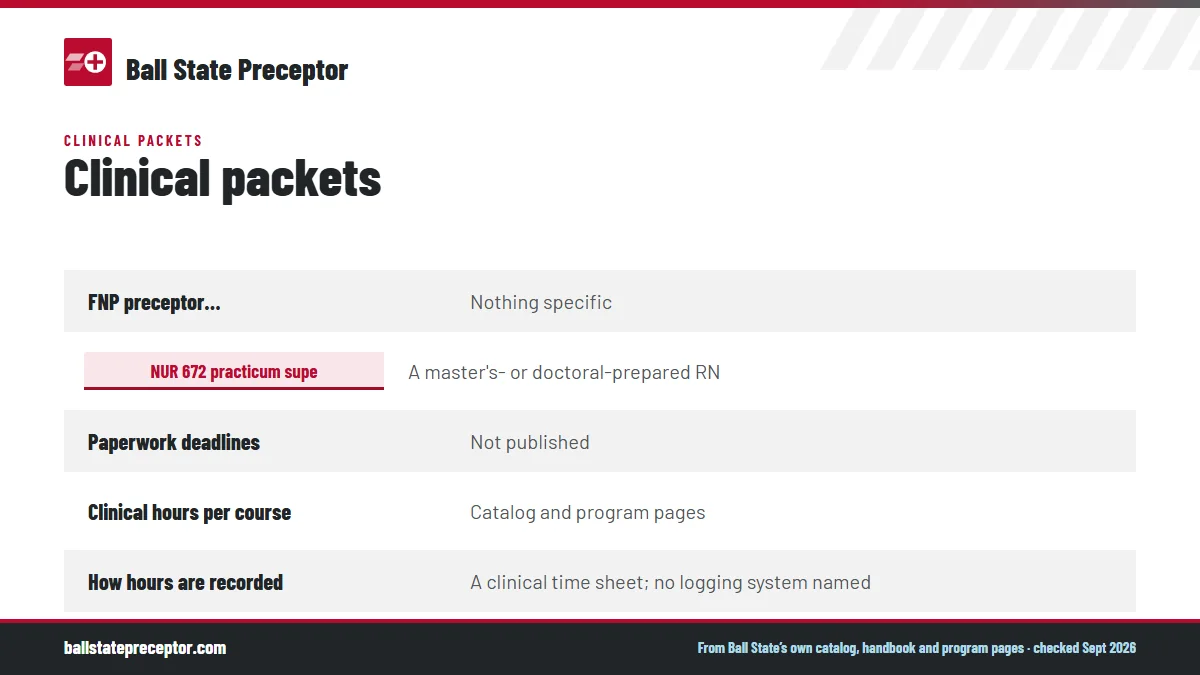
| Topic | What Ball State publishes | Where the detail lives |
|---|---|---|
| FNP preceptor qualifications | Nothing specific | Packet: preceptor qualification and responsibilities |
NUR 672 practicum supervisor | A master's- or doctoral-prepared RN | Packet forms for the particulars |
| Paperwork deadlines | Not published | Packet: submission policies and deadlines |
| Clinical hours per course | Catalog and program pages | The clinical hours planner |
| How hours are recorded | A clinical time sheet; no logging system named | Packet and course faculty |
| Who evaluates you | Course faculty and preceptors, plus a clinical supervisor in certain states | Packet evaluation forms |
| Health clearance items | The full list, in the handbook | American Data Bank |
Evaluations, time sheets and pass/fail clinicals
Your clinical evaluators are your course faculty and your preceptor; for students who reside in some states, a clinical supervisor adds a third assessment. Clinical evaluations are satisfactory or unsatisfactory, and an unsatisfactory clinical evaluation brings a grade of F for the course.
That F carries weight. The minimum passing grade in NUR courses is a B, a course may be repeated only once, and a second failed course of any kind leads to dismissal. An Incomplete in NUR 634 or in NUR 681 through NUR 684 also holds back the next NP clinical course; the grades and time limits guide has the detail. The packet's student and preceptor evaluation forms and its time sheet are the paper trail behind all of this, so keep them current through the term.
How we work from your packet
Your packet is the checklist we build to. Tell your placement advisor what your concentration's packet asks of a preceptor and when its paperwork is due, and we screen candidates against those qualifications before you meet them. We collect the details the forms call for, brief the preceptor on the evaluation forms and time sheet ahead, and set the agency agreement moving on a timeline that clears the packet's deadlines with room to spare.
What reaches course faculty and School of Nursing staff arrives complete, so their review can focus on fit rather than missing pieces. When your packet and a public Ball State page seem to disagree, we flag the point for you to raise with course faculty. Start with the form below.
Questions Ball State students ask
Can I see the Ball State clinical packet before I am admitted?
No. The packets sit behind the Canvas login in the Nursing Grad Students Community, and Ball State's MS FAQ says clinical requirements reach admitted students after orientation. Until then, the graduate catalog, the program pages and the Graduate Nursing Handbook are the public sources for hours, settings and planning rules.
What qualifications does a Ball State FNP preceptor need?
Ball State keeps them in the clinical packet rather than on a public page; the handbook files them under preceptor qualification and responsibilities. The one public preceptor rule covers the NUR 672 practicum, which needs an RN with a master's or doctoral degree. The preceptor requirements guide gathers what is public and what to confirm.
Do the clinical packets differ by concentration?
Yes. The handbook describes separate packets by concentration, Nurse Practitioner, Educator and Administrator, and asks each student to know the packets for their own concentration. Certificate and DNP students should ask their advisor which packet applies to them, since the handbook's list names concentrations rather than programs.
Where do I submit completed clinical forms?
Follow the submission policies in your packet. Handing in clinical paperwork falls within the SON Graduate Program and Compliance Coordinator's remit under the handbook's staff list. Because late or missing clinical forms can affect progression, raise any doubt about where a form goes well before its deadline.
Who can explain a packet rule I do not understand?
Start with your course faculty, who handle questions about clinical requirements, preceptors and hours. If you are unsure who owns a question, the handbook says the Graduate Clinical Placement Coordinator will direct you to the right person, and concerns left unresolved after speaking with course faculty go to the Graduate Programs Director. See who does what.
Related pages
Last checked 2026-09-26
We check these pages against Ball State's own catalog, graduate handbook, program pages and State Authorization Map, and Indiana rules. Your course faculty, your advisor and the Graduate Clinical Placement Coordinator have the final word.
Ball State asks you to find your preceptor. We find one near you.
Tell us your Ball State track, where you live and when your next clinical course starts. We find preceptors near you who fit the course, confirm the practice will sign Ball State's affiliation agreement, and line up a backup, so the School of Nursing can clear the site before the semester.
- Preceptors matched to the course: pediatrics for
NUR 682, women's health forNUR 684, adult primary care forNUR 681andNUR 683 - Outside your own unit or clinic, in a state where Ball State's program is authorized
- Across Indiana, from Muncie to Evansville, and in the other states Ball State accepts
Start your placement plan
Program, city and start date is all we need to begin.