The Indiana State Board of Nursing and what it means for Ball State students
Indiana's State Board of Nursing, housed in the Indiana Professional Licensing Agency (PLA), licenses nurses and approves the programs that lead students to their first nursing license, among them Ball State's BSN. It does not review graduate programs, so Ball State's MS in Nursing, certificate and DNP rely on national accreditation instead. For graduate students the Board touches two things: the RN license you hold now and the prescriptive authority you may seek after graduation.
Clinicals in Indiana, planned around Indiana's rules
Tell us your Ball State program, course and county. We check each preceptor's license and the site's own student rules before proposing them.
What the Board oversees, and what it leaves to others
The Board sits inside the PLA, and its licensing, education and APRN pages all live on the PLA's site. On education, the Board describes its accreditation as reaching the Indiana programs that train students for an initial RN or LPN license, and stopping there: RN-BSN completion programs and graduate nursing programs sit outside its review.
Ball State's documents follow that split. The School of Nursing's Section I handbook says the Baccalaureate Nursing program is approved by the Indiana State Board of Nursing, while CCNE, a national accreditor, covers the bachelor's and master's degrees and the post-graduate APRN certificate, as explained on the accreditation page.
So there is no Indiana Board approval behind Ball State's online graduate programs, and none is expected. The Board's published rules also set no approval step for a graduate program, from Indiana or elsewhere, that places NP students at Indiana sites.
The Board's rules for pre-licensure programs
Most of Indiana's written rules on nursing education, in 848 IAC 1-2 and in IC 25-23-1-20.2 and 20.3, apply to LPN, associate degree, diploma and bachelor's programs. They help explain why Ball State places its BSN students itself while its graduate students search for their own preceptors.
- Written agreements: a pre-licensure program needs one with every agency it uses for clinical experience, setting out both sides' responsibilities. Observation-only visits are the exception.
- Faculty in charge: nursing faculty assign, guide, evaluate and supervise students' clinical learning.
- Preceptorships: permitted with written selection criteria, clinical objectives shared before the experience, an RN preceptor with at least three years of experience, a designated faculty member reachable by phone or in person, and no more than ten students per coordinating faculty member.
- Clinical preceptor by statute: a licensed nurse employed by the cooperating agency who supervises one student at a time. The Board was directed to adopt rules on this by July 1, 2025, and the published rule text still carries the three-year standard, so whether new rules are in force is unclear.
- Settings and simulation: pre-licensure clinical hours must include at least one hospital and one other health facility, and a program whose overall NCLEX pass rate is at least 80% may use simulation for up to half of its clinical hours.
None of these reach Ball State's MS, certificate or DNP courses. For how the School arranges BSN clinicals in east-central Indiana, see BSN clinicals.
Your RN license in Indiana
Ball State's 2026-27 graduate catalog asks every graduate nursing student to hold an RN license that is active and unencumbered in their state of practice, and that license is part of your clearance record in American Data Bank. For nurses licensed in Indiana, the license comes through the PLA, and every Indiana RN license expires on October 31 of odd-numbered years.
Indiana joined the Nurse Licensure Compact, with implementation on July 1, 2020. The PLA's own guidance speaks of nurses working on an Indiana RN license or an out-of-state compact RN license, so a nurse holding a multistate license issued by another compact member can practice in Indiana on it.
Individual health systems can ask for more than the state does. IU Health's student page limits eligibility to students whose primary residence and nursing licensure are both in Indiana, and Deaconess asks NP students for RN licensure as the Indiana PLA defines it. Ball State's own license rules, including what to upload after a move, are on the RN license requirements page.
Indiana and the APRN Compact
Advanced practice has a separate agreement, the APRN Compact, and Indiana has not enacted it. Only five states have enacted it, Utah, Wyoming, Delaware and the two Dakotas, and the compact cannot operate until seven join. At its May 2026 APRN Roundtable, NCSBN said its board had charged staff with working alongside boards of nursing on a redesign.
For a new FNP, Indiana prescriptive authority is therefore an Indiana credential only. If you plan to practice in a second state, you apply to that state's board on its own terms. Ball State's online programs also carry their own state limits, set by Ball State rather than by any board; the state authorization guide lists them.
How Indiana grants APRN authority
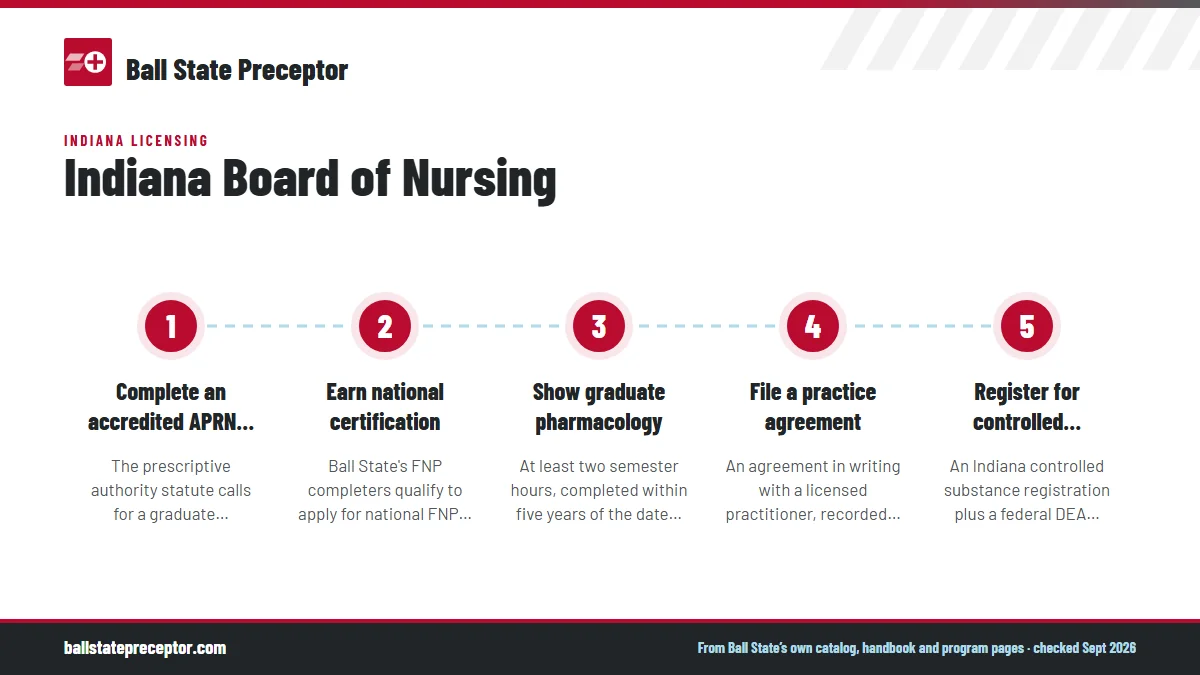
Indiana uses the APRN license for prescriptive authority, not as permission to practice as a nurse practitioner; NPs who do not prescribe practice on their RN license. For a Ball State FNP graduate who wants to prescribe in Indiana, the path runs in this order:
- Complete an accredited APRN programThe prescriptive authority statute calls for a graduate, postgraduate or doctoral APRN program from an accredited college or university. The Board's definitions also cover certificate programs, and certificate graduates must hold and keep national NP certification.
- Earn national certificationBall State's FNP completers qualify to apply for national FNP certification through ANCC or AANP. The certification exams page covers timing and the board review in
NUR 673. - Show graduate pharmacologyAt least two semester hours, completed within five years of the date you apply. Ball State's
NUR 638Advanced Clinical Pharmacology is a three-credit course, so a long gap between it and your application is worth raising with the PLA. - File a practice agreementAn agreement in writing with a licensed practitioner, recorded in MyLicense One. What it must contain is on the Indiana NP practice page.
- Register for controlled substances if you need themAn Indiana controlled substance registration plus a federal DEA registration.
- Keep it activeMaintain an active agreement at all times and complete the PLA's continuing education: at least 30 hours, with at least 8 in pharmacology.
What the Board leaves to Ball State and to you
Several questions students bring to the Board are answered elsewhere. Neither Indiana statute nor Board rule says who must find preceptors for APRN students; Ball State's rule does, with faculty support if issues arise. Where you may live and train comes from Ball State's State Authorization Map. Whether your degree leads to a license in another state is a question for that state's licensing agency, which is where Ball State itself sends students, since it publishes no state-by-state licensure findings. And the qualifications an FNP preceptor must meet are in Ball State's clinical packets.
Our placement desk works inside both sets of rules: Ball State's for the course and Indiana's for the people who precept it. We confirm each Indiana preceptor's license is active and unrestricted and check the health system's own student rules, such as IU Health's residence and license limit, before a name reaches you. Request a placement when your next course is in sight.
Questions Ball State students ask
Is Ball State's online MS in Nursing approved by Indiana's nursing board?
No, and it is not designed to be. By the Board's own account, graduate nursing programs sit outside its review and accreditation. Ball State's master's and post-graduate APRN certificate are accredited by CCNE, while the Board's approval covers the Baccalaureate Nursing program, which leads to a first RN license.
Do I need an Indiana APRN license to work as a nurse practitioner?
Only if you will prescribe. The PLA describes the APRN license as authority to prescribe and says NPs who do not need that authority practice on their Indiana or out-of-state compact RN license. Prescribing takes the APRN license plus an active practice agreement on file.
Can I do Ball State clinicals in Indiana on another state's multistate license?
Indiana recognizes out-of-state compact RN licenses for practice, and Ball State's catalog wants your RN license active and unencumbered wherever you practice. Some sites are stricter: IU Health wants students whose residence and nursing license are both in Indiana. Confirm with the site before you count on it.
Who at Ball State verifies my education for a license?
The Graduate Nursing Handbook assigns education verification, for certification boards and for other states' licensing boards, to the Graduate Programs Director, who also handles the NP certification exam application. Raise it early in your final semester so verification is not the last item holding up an application.
When is the next Indiana RN license expiration date?
October 31, 2027. Indiana sets RN license expiration for October 31 in each odd-numbered year. Renew ahead of that date and upload the renewed license to American Data Bank, because Ball State's clearance record has to show a license number and a current expiration date.
Related pages
Last checked 2026-09-26
We check these pages against Ball State's own catalog, graduate handbook, program pages and State Authorization Map, and Indiana rules. Your course faculty, your advisor and the Graduate Clinical Placement Coordinator have the final word.
Ball State asks you to find your preceptor. We find one near you.
Tell us your Ball State track, where you live and when your next clinical course starts. We find preceptors near you who fit the course, confirm the practice will sign Ball State's affiliation agreement, and line up a backup, so the School of Nursing can clear the site before the semester.
- Preceptors matched to the course: pediatrics for
NUR 682, women's health forNUR 684, adult primary care forNUR 681andNUR 683 - Outside your own unit or clinic, in a state where Ball State's program is authorized
- Across Indiana, from Muncie to Evansville, and in the other states Ball State accepts
Start your placement plan
Program, city and start date is all we need to begin.