BSN clinicals at Ball State: placed by the School, supervised by faculty
In Ball State's on-campus BSN, clinical placements are the School of Nursing's job, not yours. The School places students with agencies across east-central Indiana, and nursing faculty supervise the learning, from the first health appraisal course to a final semester working directly with a nurse. Your part is to keep your clearance current, get yourself to each site by car and make the most of every shift.
Get your placement plan
Tell us your Ball State program and where you live. A placement advisor replies with preceptor and site options in your community that fit your Ball State course.
The School of Nursing arranges BSN clinicals
This is the clearest difference between Ball State's BSN and its online graduate programs. For pre-licensure students, the School of Nursing arranges clinical placements. Ball State's bachelor's page points to its strong relationships with clinical agencies across east-central Indiana, and says students take the skills they learn in the laboratory into real clinical settings under the supervision of nursing faculty.
Indiana's rules for pre-licensure programs work the same way. The Indiana State Board of Nursing's rules call for written agreements between a program and every agency it uses for clinical experiences, and they make nursing faculty responsible for assigning, guiding, evaluating and supervising students' clinical learning. When a pre-licensure program uses clinical preceptors, the current rule text asks for RN preceptors with at least three years of experience and a designated faculty member responsible for each student's learning. The Indiana Board of Nursing rules guide covers them in more depth.
In practice that means you receive your clinical assignments rather than build them. The School's baccalaureate staff, including the Baccalaureate Program Coordinator and the baccalaureate programs directors, are the people to ask when a question about a placement comes up.
The BSN tracks
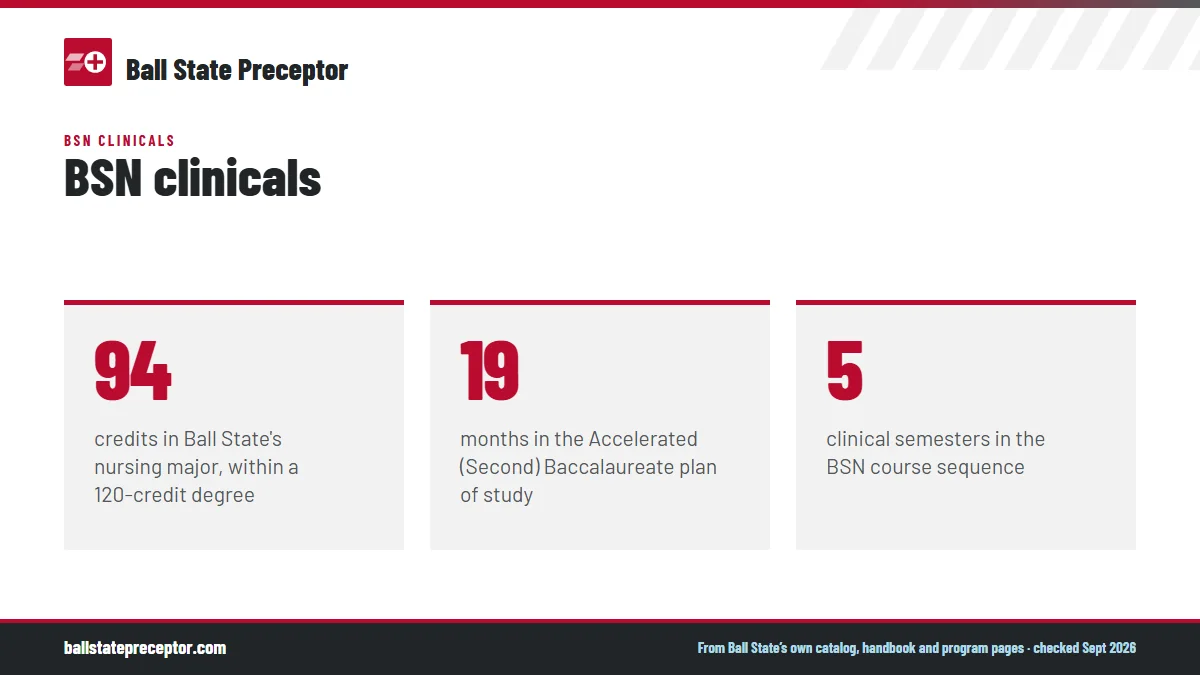
Every track leads to the same BS in Nursing, a 94-credit major inside a 120-credit degree that is accredited by CCNE and approved by the Indiana State Board of Nursing. The tracks differ in pace and in who they admit.
| Track | Pace | Entry notes |
|---|---|---|
| Regular | Four-year plan, with five clinical semesters after upper-division entry | Competitive entry each term, ranked on nursing GPA (30%), entrance exam (35%) and Ball State GPA (35%) |
| Degree in 3 | Eight semesters, summers included | The same nursing major on a compressed calendar |
| Accelerated (Second) Baccalaureate | 19-month plan; five nursing terms back to back, summer included | For students with a prior bachelor's; 2.75 GPA; fall or spring start; 32 credits granted for the earlier degree |
| LPN to BS | Set by your plan of study | Requires an unencumbered Indiana LPN license |
Ball State also lists a PNE option linked to ROTC. For upper-division nursing, applications are due in the first 10 school days of the semester before you would start, and entry is decided on a term-by-term basis.
Five clinical semesters, in order
The clinical courses come in a fixed sequence, paired by semester. The table follows the Regular plan in the Baccalaureate Program Handbook; accelerated students take the same pairings as five back-to-back terms.
| Semester | Nursing courses |
|---|---|
| Semester 4 | NUR 230 Health Appraisal Across the Lifespan; NUR 231 Fundamental Nursing Skills |
| Semester 5 | NUR 330 Adult Health 1; NUR 350 Behavioral Health (plus statistics) |
| Semester 6 | NUR 340 Adult Health 2; NUR 370 Pediatrics; NUR 322 Research in Nursing |
| Semester 7 | NUR 402 Adult Health 3; NUR 404 Population Health; NUR 406 Nursing of Childbearing Families |
| Semester 8 | NUR 423 Seminar: Transition to Practice; NUR 425 Leadership and Management; NUR 430 Adult Health 4 |
Ball State does not publish clinical hours for individual BSN courses. It describes NUR 330 as spanning hospital and community settings, and NUR 430 as critical care in which, as Ball State's bachelor's page puts it, you work directly with a nurse in various areas of practice. NUR 423, the transition-to-practice seminar, prepares you for the NCLEX.
Where clinicals happen, and why you need a car
Clinical agencies are spread across the region, not concentrated in Muncie. The 2026-27 Baccalaureate Program Handbook lists sites in Anderson, Elwood, Fort Wayne, Greenfield, Indianapolis, Kokomo, Marion, Muncie, Portland and Richmond, and it states plainly that students must have access to a car for all clinical experiences.
Some of those towns are a long drive from campus, so plan work hours, housing and transportation around clinical days before each semester starts. Ball State does not publish which semesters use which towns, so ask early in the term if a long commute would affect your schedule.
Ball State's nursing history is rooted in the same region. The School's heritage dates to 1906, its diploma program was based at Ball Memorial Hospital from 1929 to 1967, the Department of Nursing was established in 1963, and it became the School of Nursing in 1985. The east-central Indiana guide describes the region's health systems and counties.
Clearance before your first clinical
A placement only goes ahead once you are cleared. The baccalaureate handbook's requirements include a physical exam and an N95 form, and the undergraduate catalog requires criminal background checks and Medicare/Medicaid exclusion screenings at admission and every year after.
The drug screen deserves particular care. The baccalaureate handbook warns that a positive result may affect your ability to be approved for required clinical placement assignments, so read the School's drug screening policy in full, including anything it says about CBD products, before you test.
Clinical paperwork runs through CORE-ELMS, which the baccalaureate handbook names along with its Electronic Forms and Document Library features. Each baccalaureate student in a clinical is also covered by Ball State University's professional liability insurance policy. Graduate students use a different set of rules, set out in the clinical compliance requirements guide, which is worth a look if you plan to continue at Ball State.
Simulation, outcomes and student life
Clinical learning at Ball State also happens in simulation. The School runs nine simulation and skills laboratories, among them the Cardinal Simulation Lab with 11 hospital beds, obstetrics and pediatric simulation labs, and a Standardized Patient Suite where live patient actors work across 12 exam rooms. Indiana law lets a pre-licensure program with an NCLEX pass rate of at least 80% use simulation for up to half of its clinical hours, while still requiring clinical hours in at least one hospital and one other health facility. Ball State does not publish how it divides hours between the two.
On outcomes, Ball State reports a 94% NCLEX pass rate for 2024 on its bachelor's page, while the School of Nursing's about page cites an 89% pass rate for licensing exams without naming a year. The two figures come from different Ball State pages, and neither explains the other. The CCNE directory lists the baccalaureate program as accredited through June 30, 2031; the accreditation guide covers the details.
Outside class, the Ball State Student Nurses Association and the Nursing Living-Learning Community in Woodworth Complex give nursing students a community on campus.
Thinking ahead to graduate school
Most of our work is with Ball State's graduate students, and for a BSN student our role is a modest one: helping you see what comes later. If you plan to return for a nurse practitioner degree, the placement model changes completely. Ball State's online FNP students find their own preceptors in their community, start planning about a year ahead, have each agency sign an affiliation agreement, and may be asked for proof of 500 hours of RN work before any graduate clinical course. Graduate students must also live in, and train in, a state where the program is authorized.
The best preparation now is a strong start as an RN and good working relationships with the nurse practitioners you meet along the way. When you reach the graduate stage, we take on the preceptor search, matched to the exact Ball State course. The MS in Nursing FNP guide and how it works explain that path, and the request form is there when your first graduate clinical comes into view.
Questions Ball State students ask
Do Ball State BSN students find their own clinical sites?
No. In the on-campus BSN tracks, the School of Nursing places students with clinical agencies across east-central Indiana, and nursing faculty supervise the clinical learning. That is different from Ball State's online FNP programs, where students find their own preceptors in their community with faculty support if issues arise.
How far will I travel for Ball State nursing clinicals?
It varies. The baccalaureate handbook lists sites from Muncie to Anderson, Elwood, Fort Wayne, Greenfield, Indianapolis, Kokomo, Marion, Portland and Richmond, and requires every student to have access to a car. Ball State does not publish which semester uses which town, so budget time and fuel for longer drives in any term.
Does a positive drug screen end a Ball State BSN placement?
The baccalaureate handbook says a positive result may affect your ability to be approved for required clinical placement assignments. It does not promise a particular outcome, so read the full drug screening policy before testing and speak with the School of Nursing's baccalaureate staff if you have questions about a medication or product.
Is Ball State's BSN accredited?
Yes. The CCNE directory lists Ball State's baccalaureate nursing program as accredited through June 30, 2031, and Ball State says the program is also approved by the Indiana State Board of Nursing. Ball State's 2026-27 Section I handbook gives June 2030 instead, so the CCNE directory is the better source for the end date.
Does the accelerated BSN include summer clinicals?
Yes. Ball State's June 2026 accelerated plan runs five nursing terms back to back, with terms labeled fall or spring, spring or summer and so on depending on your start, and each term carries clinical courses. Over its 19 months, expect clinicals in terms that a Regular-track student would spend on break.
Related pages
Last checked 2026-09-26
We check these pages against Ball State's own catalog, graduate handbook, program pages and State Authorization Map, and Indiana rules. Your course faculty, your advisor and the Graduate Clinical Placement Coordinator have the final word.
- Ball State School of Nursing: bachelor's degrees
- Ball State 2026-2027 Undergraduate Catalog: School of Nursing
- Ball State School of Nursing: current student resources and Baccalaureate Program Handbook
- Ball State School of Nursing: simulation and skills laboratories
- Indiana Administrative Code 848 IAC 1-2-19 (Cornell LII)
Ball State asks you to find your preceptor. We find one near you.
Tell us your Ball State track, where you live and when your next clinical course starts. We find preceptors near you who fit the course, confirm the practice will sign Ball State's affiliation agreement, and line up a backup, so the School of Nursing can clear the site before the semester.
- Preceptors matched to the course: pediatrics for
NUR 682, women's health forNUR 684, adult primary care forNUR 681andNUR 683 - Outside your own unit or clinic, in a state where Ball State's program is authorized
- Across Indiana, from Muncie to Evansville, and in the other states Ball State accepts
Start your placement plan
Program, city and start date is all we need to begin.