Ball State's RN-to-MS option: the bridge courses and what comes after
Ball State's RN-to-MS option lets a registered nurse with an associate degree in nursing and a bachelor's degree in another field enter the online MS in Nursing without earning a BSN first. You add up to three bridge courses, NUR 303, NUR 404 and NUR 405, each with 45 clinical hours, then complete a concentration. Ball State's current pages do not say who arranges the bridge clinical hours, so that is the first thing to settle.
Get your placement plan
Tell us your Ball State program and where you live. A placement advisor replies with preceptor and site options in your community that fit your Ball State course.
Who the RN-to-MS option is for
The option fits one specific profile. The 2026-27 Graduate Catalog says RN-MS applicants must hold an associate degree in nursing from a program accredited by NLNAC, ACEN or NLN CNEA, together with a bachelor's degree in a field other than nursing. If your bachelor's is already in nursing, you apply to the MS in Nursing directly.
The rest of admission follows the MS in Nursing. The catalog and application page ask for a 3.0 GPA, an active, unencumbered RN license and three letters of recommendation. The two sources treat GPAs between 2.8 and 2.99 differently: the application page describes a probationary or conditional admission, while the catalog uses the term earned admission status, so ask admissions how your GPA will be handled. The FNP concentration offers no probationary or conditional admission at all.
The MS admits in fall, spring and summer, with priority deadlines of July 19 for fall, September 15 for spring and February 15 for summer. Later applications are considered while seats remain, up to two weeks before the term, and the next listed start is January 11, 2027.
The three bridge courses
Ball State's MS in Nursing page lists up to three bridge courses, taken before the master's courses, and says each one requires 45 clinical hours on top of its coursework. By our count that is as many as 135 bridge hours before your first graduate clinical. Your plan of study, emailed after admission, shows which of the three you need.
| Course | Credits | Clinical hours | What the clinical involves |
|---|---|---|---|
NUR 303 Health Assessment | 3 | 45 | Shadow Health Digital Clinical Experiences plus a health assessment of a surrogate patient |
NUR 404 Community Health (Population Health in the catalog) | 4 | 45 | Community settings such as a women's shelter, a school nurse office, a group home or a local or state public health department |
NUR 405 Management and Leadership | 3 | 45 | Working with a nurse manager above the level of charge nurse |
A caution on the last column. Those descriptions come from the 2026-27 Baccalaureate Program Handbook, in its section on the RN to BS track, which uses the same course numbers. Ball State publishes no separate description for RN-to-MS sections, so confirm with your course faculty that yours follow the same pattern. The name of NUR 404 also varies: Community Health on the MS page and in the handbook, Population Health in the undergraduate catalog. It is the same course number either way.
Who arranges the bridge clinical hours: unclear right now
This is the open question for RN-to-MS students, and it is worth settling before your first bridge term. Ball State's current MS page says each bridge course carries 45 clinical hours but does not say who finds the setting or the supervising nurse.
The documents around it point in different directions. Ball State's archived Fall 2018 master's information packet told RN-to-MS students they were responsible for securing their own clinical placements; that packet is years old and should not be read as current policy. The current MS FAQ describes an active role for students in securing every clinical placement the degree requires, with faculty on hand to help if problems come up. For the on-campus BSN, by contrast, the School places students itself.
Our reading is to expect an active role and to ask early. Your DOSL advisor, the Graduate Clinical Placement Coordinator and the course faculty for NUR 303 can tell you whether the School arranges bridge settings for your term or expects you to propose them.
If you do end up finding bridge sites yourself, the settings are more varied than an NP placement but the lead time is real: a community agency or a nurse manager still has to agree, and the course will have its own clinical paperwork to complete. Start the conversation the term before the course.
After the bridge: your MS in Nursing concentration
With the bridge courses done, you follow the same path as any MS in Nursing student: an 18-credit core shared by every concentration, including NUR 610, which carries 45 clinical hours on the FNP and Nurse Educator pages (the Leadership and Management page lists none), and then your concentration courses.
The three concentrations
- Family Nurse Practitioner: 48 credits and 690 clinical hours across
NUR 634,NUR 681,NUR 682,NUR 683,NUR 684andNUR 673, including one required 8-hour clinical day on campus in Muncie duringNUR 681. Ball State tells FNP students they will find their own preceptors; the MS in Nursing FNP guide has the full picture. - Nurse Educator: 40 credits, with the 180-hour
NUR 672practicum plus 60 clinical hours inNUR 634. See the Nurse Educator guide. - Leadership and Management: 40 credits in the catalog (the web pages say 40 to 48) and the 180-hour
NUR 672practicum, which may be completed at your workplace under a master's- or doctoral-prepared RN. See the Leadership and Management guide.
Ball State's public pages present RN-to-MS as a route into the MS in Nursing without tying it to one concentration, so confirm with admissions that the concentration you want accepts RN-to-MS entrants in your start term. Ball State suggests planning for 6 to 10 hours a week of online coursework and 8 to 12 hours a week in clinical courses, and most of its online nursing students take about 6 credits a term.
Residence, license, clearance and the 500-hour rule
The MS in Nursing's residence rule applies to RN-to-MS students too. Both your home and every clinical hour have to be in a state on Ball State's authorized list for the master's. The master's is authorized in 26 jurisdictions on Ball State's State Authorization Map, Indiana and DC among them, and a student who moves to a state off that list cannot progress. The state authorization guide lists them.
Your RN license must be active and unencumbered in the state where you practice, and the catalog warns that you may need to document 500 or more hours of RN work before starting any clinical course. For a newer associate-degree nurse, check that figure against your planned start; whether the bridge courses count as clinical courses for this rule is a question for your advisor.
Health clearance runs through American Data Bank from acceptance. The graduate handbook's list includes immunizations, a 10-panel drug screen, a background check, BLS or ACLS certification and RN license documentation, with a CORE account linked in your first clinical semester. The American Data Bank and CORE guide covers deadlines and review times.
Planning the whole path
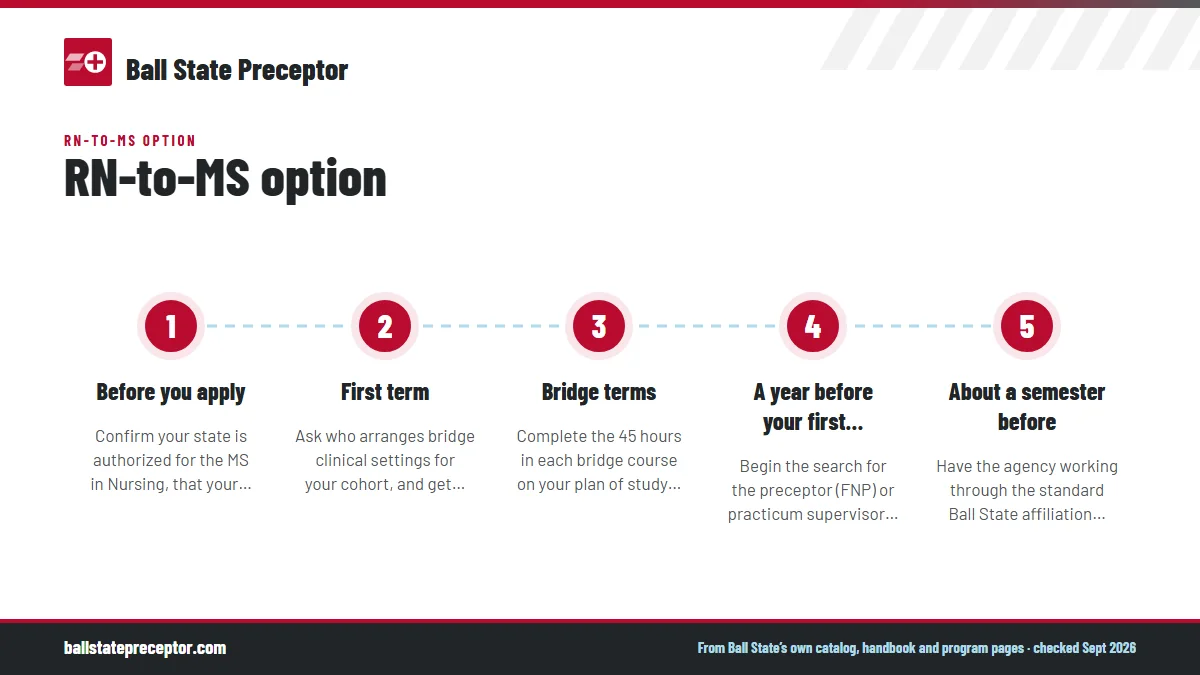
Because the bridge adds a term or more before the graduate clinicals, RN-to-MS students have more runway than most, and the best use of it is to start the graduate preceptor search while the bridge is still under way.
- Before you applyConfirm your state is authorized for the MS in Nursing, that your associate degree's accreditor is one the catalog names, and that your RN hours will meet the 500-hour threshold in time.
- First termAsk who arranges bridge clinical settings for your cohort, and get every American Data Bank item approved before clinical hours begin.
- Bridge termsComplete the 45 hours in each bridge course on your plan of study, keeping every form and evaluation the course asks for.
- A year before your first graduate clinicalBegin the search for the preceptor (FNP) or practicum supervisor (
NUR 672) that course needs, as Ball State's graduate handbook advises. - About a semester beforeHave the agency working through the standard Ball State affiliation agreement, and keep a backup agency lined up for the same term.
How we help RN-to-MS students
We support RN-to-MS students at both stages. If your bridge courses ask you to line up a setting, your placement advisor looks for a community agency that suits NUR 404 or a nurse manager above charge-nurse level for NUR 405, and helps you prepare what the course asks for.
The larger payoff comes next. Because the FNP preceptor search runs about a year ahead, we can start on NUR 634 and NUR 681 while you are still in the bridge, so your first graduate clinical opens with a confirmed preceptor, a site checked against Ball State's rules, the affiliation agreement paperwork ready and a backup agency in reserve. Tell us your concentration, your state and the term your first clinical course starts.
Questions Ball State students ask
Do I need a BSN to get into Ball State's MS in Nursing?
Not if you qualify for the RN-to-MS option. With an associate degree in nursing from an NLNAC, ACEN or NLN CNEA accredited program and a bachelor's in another field, you can enter the MS and take up to three bridge courses first. Without a bachelor's degree of any kind, this route is not available.
How many clinical hours are in Ball State's RN-to-MS bridge?
Each bridge course requires 45 clinical hours, and you take up to three, so as many as 135 hours by our count. Those sit before the master's clinical hours: 690 in the FNP concentration plus 45 in NUR 610, or the 180-hour NUR 672 practicum and related hours in the role concentrations.
Is Ball State's RN to BS the same program as RN-to-MS?
No. RN to BS is a separate post-licensure bachelor's track that shares course numbers such as NUR 303, NUR 404 and NUR 405. It does not appear in the 2026-27 undergraduate catalog, although the 2026-27 baccalaureate handbook still describes it. RN-to-MS sits inside the MS in Nursing.
Can I do RN-to-MS bridge clinical hours where I work?
Ball State does not say for the bridge courses. The MS FAQ rules out your own unit or clinic for clinicals, while the role practicums may take place at your workplace. Ask your course faculty before planning bridge hours at your employer; the guide to clinicals where you work explains the general rule.
Can RN-to-MS students choose the FNP concentration?
Ball State's public pages present RN-to-MS as an entry into the MS in Nursing without limiting it to one concentration, and they do not say otherwise for FNP. Confirm with admissions before you apply. If you choose FNP, remember that its six clinical courses each need a preceptor you find, starting about a year ahead.
Related pages
Last checked 2026-09-26
We check these pages against Ball State's own catalog, graduate handbook, program pages and State Authorization Map, and Indiana rules. Your course faculty, your advisor and the Graduate Clinical Placement Coordinator have the final word.
Ball State asks you to find your preceptor. We find one near you.
Tell us your Ball State track, where you live and when your next clinical course starts. We find preceptors near you who fit the course, confirm the practice will sign Ball State's affiliation agreement, and line up a backup, so the School of Nursing can clear the site before the semester.
- Preceptors matched to the course: pediatrics for
NUR 682, women's health forNUR 684, adult primary care forNUR 681andNUR 683 - Outside your own unit or clinic, in a state where Ball State's program is authorized
- Across Indiana, from Muncie to Evansville, and in the other states Ball State accepts
Start your placement plan
Program, city and start date is all we need to begin.