What shapes the cost of a Ball State clinical placement
Each Ball State placement is quoted for one student and one course: the specialty the course calls for, where you live, how soon the term opens and how many hours the site has to carry. Here is how each of those moves the work involved, and which charges belong to Ball State rather than to us.
Get a quote for your course
Your Ball State track, next NUR course, city and start term are enough for a placement advisor to price your search.
The course you need next
The clinical course sets the size of the ask. A practice hosting NUR 634 gives 60 hours over a term; one hosting NUR 673, the final practicum, gives 180 hours at about 1.5 to 2 days a week. The more of a clinician's week a course takes, the fewer practices can say yes, and the longer the search runs.
The table shows how the FNP courses compare. Full hour detail sits on the 690-hour guide.
| Course | Hours | What the site needs | Effect on the search |
|---|---|---|---|
NUR 634 Advanced Health Assessment | 60 | Primary care or clinic setting | Shorter commitment for the practice |
NUR 681 Primary Care of the Adult 1 | 120 (8 on campus in Muncie) | Adult primary care | Wide pool of adult and family primary care practices |
NUR 682 Primary Care of Children | 120 | Pediatric patients | Narrow pool, heavy demand |
NUR 683 Primary Care of the Adult 2 | 120 | Adult primary care | Wide pool; the NUR 681 practice may fit again |
NUR 684 Primary Care of Women | 90 | A women's health caseload | Narrow pool, heavy demand |
NUR 673 Practicum-Family Nurse Practitioner | 180 | Family practice, 1.5 to 2 days a week | Largest time commitment for one preceptor |
Specialty: pediatrics and women's health
Scarcity moves cost more than anything else. NUR 682 needs a clinician who sees children and NUR 684 needs one with a women's health caseload, and fewer primary care clinicians do either than see adults. Those who do are often already hosting students from other schools, which is the competition Ball State's graduate handbook has in mind when it tells students to plan clinical experiences a year ahead.
A family practice with a broad caseload can sometimes cover these courses, and we check for that first. When it cannot, the search turns to pediatric offices and women's health practices, which takes more calls and more follow-up. The NUR 682 and NUR 684 guides describe the settings that fit.
Where you live
Location changes both the number of practices and the rules around them. Rural counties have fewer clinicians within a reasonable drive, and Ball State's archived 2018 information packet already warned that students in rural areas may have limited options. A metro area has more practices, but also more students asking them.
Health systems narrow the field further with rules of their own, each taken from the system's own student page:
- IU Health takes students only when both their home and their nursing license are in Indiana, and it matches advanced practice students through its own office.
- Community Health Network puts its own caregivers first, and Franciscan Health's NP rotation page does the same for its employees.
- Lutheran Health Network in Fort Wayne reports its NP and PA placements full, and Deaconess in Evansville says it is not taking on new school affiliations for now.
Outside Indiana, the site must sit in a state where Ball State's program is authorized, and Ball State lists health systems in a few states whose facilities it will not use. The Indiana regions guide shows the picture near you.
Timing: how much runway the search has
Ball State advises planning clinical experiences at least a year ahead, and starting tentative arrangements with the agency about a semester before the course so the affiliation agreement has time to clear. A request that arrives with that runway lets us approach practices in order, wait for the standard Ball State agreement and line up a backup without hurrying anyone.
A request that arrives a few weeks before the term changes the job. Several practices have to be approached at once, agencies that insist on their own contract may not clear in time, and some health systems close their application windows months ahead. The work is heavier, and the quote reflects it. If your term is close, read what to do this week and then send your request.
Hours, schedule and what the site asks for
Smaller details add up. A student who can only attend on certain weekdays, or who needs a site near a workplace rather than home, shrinks the list of practices that fit. A preceptor has to fit the whole course inside the term, since an unfinished NP clinical course keeps a Ball State student out of the next one.
Some sites ask for more than Ball State's own clearance list, such as extra onboarding modules, and some agencies require their own contract rather than Ball State's standard agreement. Students residing in certain states may also need a clinical supervisor, a second person at the site. Each of these takes time to arrange, and your placement advisor accounts for them when pricing your search.
Ball State's own charges are separate
What you pay us covers our search and preparation. Ball State's charges are billed by Ball State and sit apart from ours:
- Tuition, a clinical course fee on each graduate clinical course with a small insurance charge, and a nursing program fee each term, all billed by Ball State.
- The board review course that FNP students take inside
NUR 673, which the handbook says students pay for directly to the company providing it. - Every health clearance and compliance cost, from the drug screen and background check to vaccines and the CPR card, which the handbook places on the student with no reimbursement from the School of Nursing.
- Travel to clinical sites, which the catalog assigns to the student, and the trip to Muncie for the
NUR 681campus day.
The full clearance list and how often each item renews are on the compliance checklist.
How your quote is put together
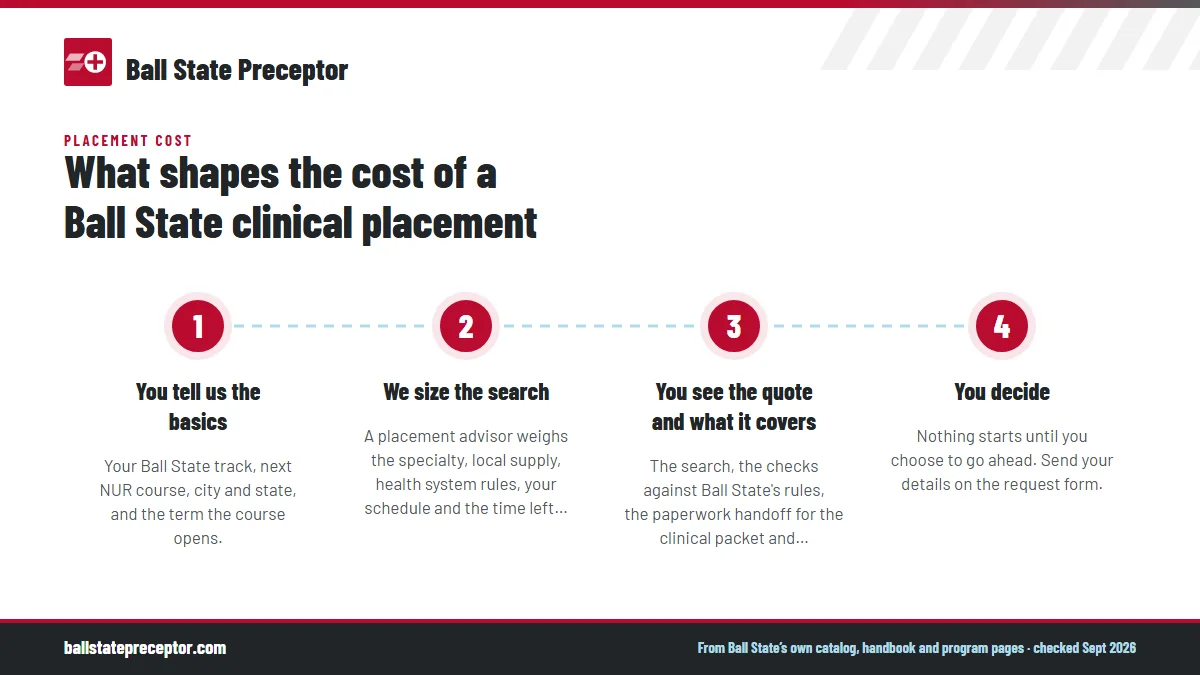
- You tell us the basicsYour Ball State track, next NUR course, city and state, and the term the course opens.
- We size the searchA placement advisor weighs the specialty, local supply, health system rules, your schedule and the time left before the term.
- You see the quote and what it coversThe search, the checks against Ball State's rules, the paperwork handoff for the clinical packet and agreement, and a backup site.
- You decideNothing starts until you choose to go ahead. Send your details on the request form.
Questions Ball State students ask
Why is there no price list on this site?
Because two Ball State placements rarely involve the same work. An adult primary care site near Indianapolis a year out is a different search from a pediatric preceptor in a rural county for a course that opens next month. A placement advisor prices your course, location and timing directly, so the figure you see fits your situation.
Does a placement fee include Ball State's clinical course fee?
No. Ball State bills its own tuition, clinical course fees and program fees, and the handbook has FNP students pay the NUR 673 board review company directly. Clearance costs for American Data Bank items are also the student's own. Our fee covers the preceptor search and the preparation around it, and nothing on Ball State's bill.
Does paying for placement help mean Ball State will approve the site?
Approval stays with Ball State. Course faculty and the School of Nursing review every preceptor and site, the agency signs Ball State's affiliation agreement, and your American Data Bank clearance has to be current. Our work is to make sure what reaches Ball State fits the course, is complete and arrives early, which is what keeps approval smooth.
Can I plan several clinical courses with you at once?
Yes. The catalog's prerequisites chain the FNP clinical courses term after term, and a practice with a broad caseload can sometimes host more than one of them, so planning the next two or three together often makes sense. It also gives each search the runway Ball State recommends. Ask your placement advisor to quote the courses you want covered.
Related pages
Last checked 2026-09-26
We check these pages against Ball State's own catalog, graduate handbook, program pages and State Authorization Map, and Indiana rules. Your course faculty, your advisor and the Graduate Clinical Placement Coordinator have the final word.
Ball State asks you to find your preceptor. We find one near you.
Tell us your Ball State track, where you live and when your next clinical course starts. We find preceptors near you who fit the course, confirm the practice will sign Ball State's affiliation agreement, and line up a backup, so the School of Nursing can clear the site before the semester.
- Preceptors matched to the course: pediatrics for
NUR 682, women's health forNUR 684, adult primary care forNUR 681andNUR 683 - Outside your own unit or clinic, in a state where Ball State's program is authorized
- Across Indiana, from Muncie to Evansville, and in the other states Ball State accepts
Start your placement plan
Program, city and start date is all we need to begin.